


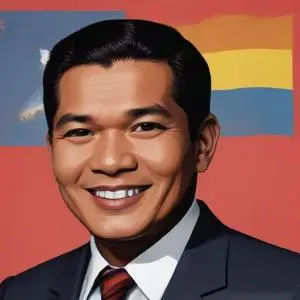
A Filipino leader who served as president from 1953 to 1957, known for his anti-corruption and social reform efforts, as well as his tragic death in a plane crash.
Ramon Magsaysay, the seventh President of the Philippines, is renowned for his extraordinary leadership, unwavering commitment to the people, and unparalleled reforms that transformed the country's governance and society. During his presidency from 1953 to 1957, Magsaysay earned the nickname "The Champion of the Common Man" for his relentless efforts to alleviate poverty, promote social justice, and strengthen democracy.
Born on August 31, 1907, in Iba, Zambales, Philippines, Magsaysay was the son of a blacksmith and a schoolteacher. His mixed Filipino, Spanish, and Chinese descent reflected the country's rich cultural heritage. He spent his early years studying in Castillejos and later attended Zambales Academy in San Narciso. Magsaysay pursued higher education at the University of the Philippines, where he enrolled in mechanical engineering, and later transferred to the Institute of Commerce at Jos Rizal College, graduating with a degree in commerce.
When World War II broke out, Magsaysay joined the motor pool of the 31st Infantry Division of the Philippine Army. His exceptional leadership skills and bravery earned him recognition, and he eventually became a guerrilla leader, fighting against the Japanese occupation. After the war, he was appointed military governor of Zambales, a position that marked the beginning of his political career.
Magsaysay's political journey began when he was elected as a Liberal Party congressman for Zambales' at-large district, serving two terms from 1946 to 1953. His outstanding performance led to his appointment as Secretary of National Defense by President Elpidio Quirino. In 1953, he ran for president under the Nacionalista Party banner and won by a landslide, becoming the youngest president of the Philippines at the age of 46.
During his presidency, Magsaysay introduced landmark reforms that addressed the country's pressing issues. He established the Agricultural Credit Administration to provide farmers with financial assistance, created the Philippine Social Security System to ensure the welfare of workers, and launched the Philippine Rural Reconstruction Movement to develop rural areas. He also strengthened the country's defense system and promoted international cooperation.
Magsaysay's leadership was guided by his strong sense of social justice, compassion, and integrity. He believed that the government's primary responsibility was to serve the people, especially the marginalized and underprivileged. His commitment to transparency and accountability set a high standard for Philippine politics.
Ramon Magsaysay's life was cut short when he died in a plane crash on March 17, 1957, along with 25 other passengers. His untimely death shocked the nation, but his legacy continues to inspire generations of Filipinos. The Ramon Magsaysay Award, established in 1958, recognizes outstanding individuals and organizations in Asia who have made significant contributions to the region's development and welfare.
Magsaysay's remarkable life and achievements serve as a testament to his unwavering dedication to the people and his country. He remains an iconic figure in Philippine history, a symbol of hope, and a beacon of inspiration for generations to come.
Born in 1890
The 6th President of the Philippines was a leader who played a crucial role in rebuilding the country after World War II, and is known for his efforts to restore the economy and promote national unity.
Born in 1892
This Filipino leader served as the 5th President of the Philippines, playing a key role in rebuilding the country after World War II and shaping its post-war economy. He's remembered for his efforts to restore national sovereignty and promote economic growth.
Born in 1878
The 4th President of the Philippines, a lawyer and politician who played a key role in the country's transition from American colonial rule to independence. He's most known for his efforts in rebuilding the war-torn nation after World War II.
Born in 1899
A Filipino soldier and politician who served as President of the United Nations General Assembly, known for his efforts to promote international cooperation and peace. He was a key figure in shaping the UN's early years.
Born in 1910
A Filipino lawyer and politician who served as the 9th President of the Philippines, known for his efforts to reform the country's economy and introduce the Filipino language as the national language.
Born in 1917
A Filipino leader who ruled with an iron fist, implementing martial law and amassing wealth, leaving a legacy of controversy and economic turmoil.
93 Years Old
First female president of the Philippines, led the People Power Revolution, and restored democracy after decades of authoritarian rule.
98 Years Old
The 12th President of the Philippines, a decorated war hero and leader who implemented economic reforms and brought stability to the country after a tumultuous era. He's known for his efforts to modernize the Philippines and promote national unity.
