


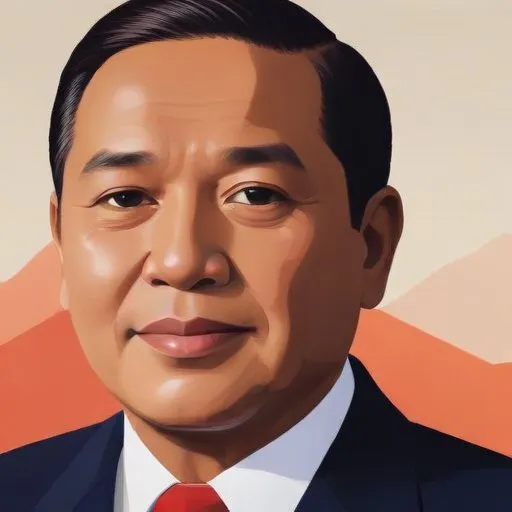
The 6th President of the Philippines was a leader who played a crucial role in rebuilding the country after World War II, and is known for his efforts to restore the economy and promote national unity.
Elpidio Quirino is a renowned Filipino lawyer and politician, best known for serving as the 6th President of the Philippines from 1948 to 1953. During his presidency, he played a crucial role in shaping the country's post-war reconstruction and economic development.
Born on November 16, 1890, in Vigan, Ilocos Sur, Quirino was the third child of Mariano Quirino y Quebral and Gregoria Rivera y Mendoza. He spent his early years in Aringay, La Union, and later studied in Caoayan, where he finished his elementary education.
Quirino's career in politics began when he became a representative of Ilocos Sur from 1919 to 1925. He then served as a senator from 1925 to 1935, during which he became a member of the Philippine Independence Commission that secured the passage of the Tydings-McDuffie Act in the United States Congress.
In 1935, Quirino was elected to the 1935 Constitutional Convention that drafted the 1935 Philippine Constitution for the newly established Philippine Commonwealth. He later served as secretary of the interior and finance under the cabinet of President Manuel L. Quezon.
After World War II, Quirino was elected vice-president in the 1946 presidential election. Following the death of incumbent President Manuel Roxas in 1948, he succeeded to the presidency and won a full term under the Liberal Party ticket in 1949.
During his presidency, Quirino faced numerous challenges, including the Hukbalahap rebellion, which ransacked towns and barrios. Despite these challenges, he implemented various programs aimed at reconstruction and economic development, including the establishment of the Philippine Rehabilitation Administration and the National Power Corporation.
Elpidio Quirino's legacy is marked by his commitment to public service and his efforts to rebuild the country after World War II. He is remembered as a strong leader who played a vital role in shaping the country's post-war development.
Elpidio Quirino's life and legacy serve as an inspiration to many, a testament to his dedication to public service and his commitment to rebuilding the Philippines after World War II.
Born in 1892
This Filipino leader served as the 5th President of the Philippines, playing a key role in rebuilding the country after World War II and shaping its post-war economy. He's remembered for his efforts to restore national sovereignty and promote economic growth.
Born in 1878
The 4th President of the Philippines, a lawyer and politician who played a key role in the country's transition from American colonial rule to independence. He's most known for his efforts in rebuilding the war-torn nation after World War II.
Born in 1869
Led the Philippine Revolution against Spanish colonial rule and later established the First Philippine Republic, becoming its first president. He's revered as a national hero for his fight for independence.
Born in 1910
A Filipino lawyer and politician who served as the 9th President of the Philippines, known for his efforts to reform the country's economy and introduce the Filipino language as the national language.
Born in 1917
A Filipino leader who ruled with an iron fist, implementing martial law and amassing wealth, leaving a legacy of controversy and economic turmoil.
93 Years Old
First female president of the Philippines, led the People Power Revolution, and restored democracy after decades of authoritarian rule.
98 Years Old
The 12th President of the Philippines, a decorated war hero and leader who implemented economic reforms and brought stability to the country after a tumultuous era. He's known for his efforts to modernize the Philippines and promote national unity.
89 Years Old
The 13th President of the Philippines, a former actor turned politician, is known for his populist appeal and controversial presidency marked by corruption allegations and an eventual impeachment trial. He's also remembered for his efforts to address poverty and inequality.
