


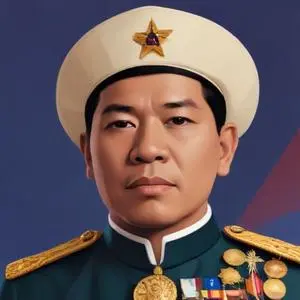
Led the Philippine Revolution against Spanish colonial rule and later established the First Philippine Republic, becoming its first president. He's revered as a national hero for his fight for independence.
Emilio Aguinaldo, also known as the "General of the Revolution," is revered as a national hero in the Philippines for his pivotal role in the country's struggle for independence against Spanish colonial rule and later, against American occupation. He is best known for being the first president of the Philippines, serving from 1899 to 1901, and leading the Philippine forces in the Philippine Revolution and the Spanish-American War.
Born on March 22, 1869, in Cavite el Viejo (present-day Kawit), Emilio Aguinaldo y Famy was the seventh of eight children to Carlos Aguinaldo y Jamir and Trinidad Famy y Villanueva. His family was well-to-do, with his father serving as the community's appointed gobernadorcillo (municipal governor) in the Spanish Viceregal administration. Aguinaldo studied at Colegio de San Juan de Letran but was forced to abandon his studies due to a cholera outbreak in 1882. He later became a cabeza de barangay (barangay captain) in 1895, and at the age of 25, he became Cavite el Viejo's first gobernadorcillo capitan municipal (municipal governor-captain) while on a business trip in Mindoro.
Aguinaldo became a Freemason in 1895, joining Pilar Lodge No. 203, Imus, Cavite, under the codename Colon. On March 7, 1895, he was initiated into the Liga Filipina, a reform movement founded by José Rizal, which aimed to advocate for Philippine independence from Spain. Aguinaldo quickly rose through the ranks, becoming the leader of the Magdalo faction, one of the two main factions of the Katipunan, a secret society founded by Andrés Bonifacio, the Supremo (Supreme Leader) of the Katipunan.
Aguinaldo played a crucial role in the Philippine Revolution against Spain, which lasted from 1896 to 1898. He led the Philippine forces to several victories, including the Battle of Binakayan-Dalahican on November 3, 1896, and the Battle of Tirad Pass on December 2, 1896. In 1898, Aguinaldo declared Philippine independence from Spain, and on January 23, 1899, he was inaugurated as the first president of the Philippines. However, his leadership was short-lived, as the country soon came under American occupation, leading to the Philippine-American War, which lasted from 1899 to 1901.
Aguinaldo's legacy has been marred by controversy, particularly his alleged involvement in the deaths of Andrés Bonifacio, the founder of the Katipunan, and General Antonio Luna, a prominent military leader during the Philippine Revolution. Additionally, his collaboration with the Japanese Empire during World War II has been heavily criticized.
Aguinaldo married Hilaria del Rosario on January 1, 1896, and they had five children together. After his presidency, Aguinaldo retired to private life, dedicating himself to farming and business. He passed away on February 6, 1964, at the age of 95, leaving behind a legacy that continues to be celebrated and debated in the Philippines.
"I would rather die than surrender my freedom and my country to the invaders." - Emilio Aguinaldo
Emilio Aguinaldo's life and leadership have had a profound impact on Philippine history and identity. His courage, determination, and vision for an independent Philippines continue to inspire Filipinos today, making him a revered figure in the country's struggle for freedom and self-determination.
Born in 1863
Co-founder of the Katipunan, a secret society that sparked the Philippine Revolution against Spanish colonial rule, fighting for independence and national freedom.
Born in 1875
A Filipino journalist and activist who played a key role in the country's struggle for independence from Spain, and is known for his writings that inspired revolutionaries.
Born in 1864
The first Prime Minister of the Philippines, a key figure in the country's struggle for independence from Spain and the United States, known for his leadership and vision for a self-governing nation.
Born in 1875
A Filipino revolutionary leader who played a key role in the country's fight for independence against Spanish and American colonial powers, known for his bravery and tactical genius.
Born in 1878
The 2nd President of the Philippines, a key figure in the country's fight for independence from the US, known for his leadership during World War II and establishing a government-in-exile.
Born in 1861
A Filipino polymath who wrote novels that sparked a revolution, exposing the harsh realities of colonial rule and inspiring a nation to fight for independence.
Born in 1850
A pioneering journalist and lawyer who fought for reforms and freedom of the press in the Philippines during the Spanish colonial era, using his writings to expose social ills and advocate for change.
Born in 1857
A Filipino artist who created stunning works that showcased the country's rich cultural heritage and struggle for independence, blending traditional and European techniques.
