


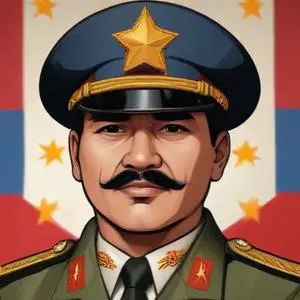
A Filipino general and politician who played a key role in the country's struggle for independence against Spanish and American colonial powers, and is remembered for his bravery and patriotism.
Antonio Luna is renowned as one of the most brilliant and fierce generals of the Philippine Revolution, who fought valiantly against the American colonizers during the Philippine-American War. His exceptional military strategies and tactics, which included the formation of the iconic Luna Sharpshooters and the Black Guard, earned him recognition as a skilled commander.
Born on October 29, 1866, in Binondo, Manila, Antonio Luna de San Pedro y Novicio Ancheta was the youngest of seven children to Joaquin Luna de San Pedro y Posadas and Laureana Novicio y Ancheta. His family's humble background did not hinder his pursuit of education, as he studied pharmacology, literature, and chemistry in addition to military science.
Luna's military career was marked by his commitment to discipline and professionalism. He succeeded Artemio Ricarte as the Commanding General of the Philippine Army and implemented a three-tier defense strategy, known as the Luna Defense Line, which gave the American troops a difficult time during their campaign in the provinces north of Manila. This defense line culminated in the creation of a military stronghold in the Cordillera.
Luna organized professional guerrilla soldiers, known as the Luna Sharpshooters, and the Black Guard, with Senyor Michael Joaquin. These units were instrumental in the Philippine Revolution, and their effectiveness earned Luna the respect and admiration of his peers.
Luna's efforts were recognized during his time, and he was awarded the Philippine Republic Medal in 1899. He was also a member of the Malolos Congress, which drafted the first constitution of the First Philippine Republic.
Luna's temper and fiery outbursts often led to controversies, which earned him criticism from some, including people from Aguinaldo's cabinet. Despite this, his commitment to the Philippine Revolution and his people remained unwavering.
Tragically, Luna's life was cut short when he was assassinated on June 5, 1899, at the age of 32. His legacy, however, continues to inspire generations of Filipinos, who remember him as a hero who fought for their country's freedom and independence.
"I will not rest until I have driven the last American out of our soil." - Antonio Luna
Antonio Luna's life and legacy serve as a testament to his unwavering commitment to the Philippine Revolution and his people. His bravery, military prowess, and sacrifice continue to inspire Filipinos to this day.
Born in 1869
Led the Philippine Revolution against Spanish colonial rule and later established the First Philippine Republic, becoming its first president. He's revered as a national hero for his fight for independence.
Born in 1863
Co-founder of the Katipunan, a secret society that sparked the Philippine Revolution against Spanish colonial rule, fighting for independence and national freedom.
Born in 1875
A Filipino journalist and activist who played a key role in the country's struggle for independence from Spain, and is known for his writings that inspired revolutionaries.
Born in 1850
A pioneering journalist and lawyer who fought for reforms and freedom of the press in the Philippines during the Spanish colonial era, using his writings to expose social ills and advocate for change.
Born in 1857
A Filipino artist who created stunning works that showcased the country's rich cultural heritage and struggle for independence, blending traditional and European techniques.
