


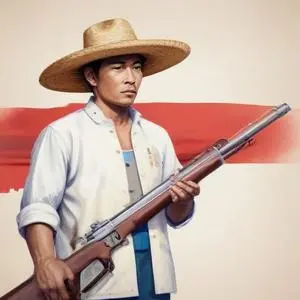
Co-founder of the Katipunan, a secret society that sparked the Philippine Revolution against Spanish colonial rule, fighting for independence and national freedom.
Andrés Bonifacio is revered as the national hero of the Philippines, and for good reason. He is often referred to as the "Father of the Philippine Revolution" for his instrumental role in igniting the fight for independence from Spanish colonial rule in the late 19th century.
Bonifacio was born on November 30, 1863, in Tondo, Manila, to Catalina de Castro and Santiago Bonifacio. His early education was facilitated by his aunt, who taught him the alphabet. Later, he was enrolled in Guillermo Osmeña's private school.
In 1892, Bonifacio co-founded the Katipunan, a secret society that sought to overthrow the Spanish colonial government and establish an independent Philippines. The society's full name, Kataastaasang, Kagalanggalang na Katipunan ng mga Anak ng Bayan, translates to " Highest and Most Respectable Society of the Children of the Nation".
Bonifacio reorganized the Katipunan into a revolutionary government, with himself as the Supreme President (Kataastaasang Pangulo). He envisioned a nation-state called Haring Bayang Katagalugan (Sovereign Nation of the Tagalog People), which encompassed all those born in the Philippine Islands, not just the Tagalog-speaking regions.
Bonifacio's philosophical contributions were rooted in his desire for freedom and self-governance. He believed in the power of collective action and the importance of unity among the Filipino people. His ideas were influenced by the writings of European thinkers, such as Jean-Jacques Rousseau and John Stuart Mill.
Bonifacio's legacy extends far beyond his revolutionary era. He is celebrated as a national hero, and his ideals of freedom and self-determination continue to inspire Filipinos today. His birthday, November 30th, is a national holiday in the Philippines.
Bonifacio's execution in 1897 was a pivotal moment in Philippine history, marking the end of one era and the beginning of another. His sacrifice paved the way for the country's eventual independence from Spain and later, from the United States.
Andrés Bonifacio's life was marked by struggle, sacrifice, and a fierce determination to free his country from colonial rule. His legacy continues to inspire generations of Filipinos, and his contributions to Philippine history remain unparalleled.
Born in 1869
Led the Philippine Revolution against Spanish colonial rule and later established the First Philippine Republic, becoming its first president. He's revered as a national hero for his fight for independence.
Born in 1861
A Filipino polymath who wrote novels that sparked a revolution, exposing the harsh realities of colonial rule and inspiring a nation to fight for independence.
Born in 1850
A pioneering journalist and lawyer who fought for reforms and freedom of the press in the Philippines during the Spanish colonial era, using his writings to expose social ills and advocate for change.
Born in 1875
A Filipino revolutionary leader who played a key role in the country's fight for independence against Spanish and American colonial powers, known for his bravery and tactical genius.
Born in 1878
The 4th President of the Philippines, a lawyer and politician who played a key role in the country's transition from American colonial rule to independence. He's most known for his efforts in rebuilding the war-torn nation after World War II.
Born in 1878
The 2nd President of the Philippines, a key figure in the country's fight for independence from the US, known for his leadership during World War II and establishing a government-in-exile.
Born in 1890
A prominent figure in the Philippines, known for his advocacy of nationalism and independence, and his influential writings on politics and law.
