


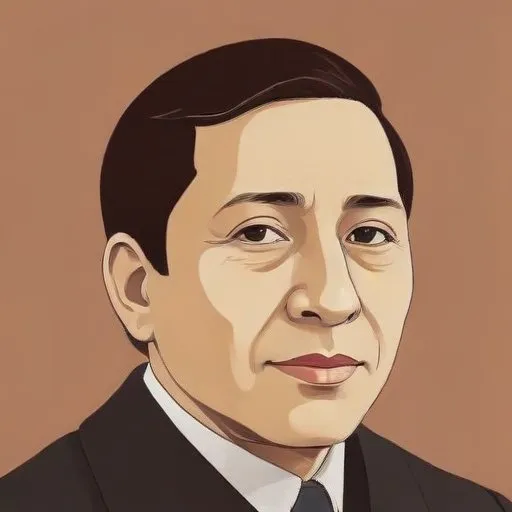
The first Prime Minister of the Philippines, a key figure in the country's struggle for independence from Spain and the United States, known for his leadership and vision for a self-governing nation.
Apolinario Mabini, a Filipino revolutionary leader, educator, lawyer, and statesman, is renowned for being the first Prime Minister of the Philippines and the "utak ng himagsikan" or brain of the revolution. His remarkable work and thoughts on government shaped the Philippines' fight for independence over the next century.
Apolinario Mabini was born on July 23, 1864, in Barrio Talaga, Tanauan, Batangas, to Dionisia Maranan y Magpantay, a vendor, and Inocencio Leon Mabini y Lira, an illiterate peasant. Despite being poor, Mabini's academic merit earned him a place in the historical school of Father Valerio Malabanan in Lipa.
Mabini was a strong advocate for independence and self-governance. His works, such as "El Verdadero Decalogo" (The True Decalogue) and "Programa Constitucional de la República Filipina" (The Constitutional Program of the Philippine Republic), became instrumental in the drafting of the Malolos Constitution.
Tragedy struck Mabini at a young age; he lost the use of both his legs to polio shortly before the Philippine Revolution of 1896. However, this did not deter him from pursuing his goals. Despite his physical limitations, Mabini continued to play a pivotal role in the revolution.
Mabini served as a legal and constitutional adviser to the Revolutionary Government and later became the first Prime Minister of the Philippines upon the establishment of the First Philippine Republic. He confronted both Spanish colonial rule and American colonial rule, eventually being captured and exiled to Guam by American colonial authorities. Mabini was allowed to return only two months before his eventual death on May 13, 1903.
Mabini's unwavering dedication to the Philippine Revolution has earned him recognition as a national hero in the Philippines. His work has inspired generations to fight for independence and self-governance. Today, Mabini's legacy continues to shape the country's political landscape.
Apolinario Mabini's remarkable life and achievements serve as a beacon of inspiration for anyone who fights for a cause. His unwavering determination and resilience in the face of adversity continue to motivate and empower individuals to strive for greatness.
Born in 1869
Led the Philippine Revolution against Spanish colonial rule and later established the First Philippine Republic, becoming its first president. He's revered as a national hero for his fight for independence.
Born in 1863
Co-founder of the Katipunan, a secret society that sparked the Philippine Revolution against Spanish colonial rule, fighting for independence and national freedom.
Born in 1861
A Filipino polymath who wrote novels that sparked a revolution, exposing the harsh realities of colonial rule and inspiring a nation to fight for independence.
Born in 1878
The 2nd President of the Philippines, a key figure in the country's fight for independence from the US, known for his leadership during World War II and establishing a government-in-exile.
Born in 1878
The 4th President of the Philippines, a lawyer and politician who played a key role in the country's transition from American colonial rule to independence. He's most known for his efforts in rebuilding the war-torn nation after World War II.
Born in 1910
A Filipino lawyer and politician who served as the 9th President of the Philippines, known for his efforts to reform the country's economy and introduce the Filipino language as the national language.
Born in 1917
A Filipino leader who ruled with an iron fist, implementing martial law and amassing wealth, leaving a legacy of controversy and economic turmoil.
93 Years Old
First female president of the Philippines, led the People Power Revolution, and restored democracy after decades of authoritarian rule.
