


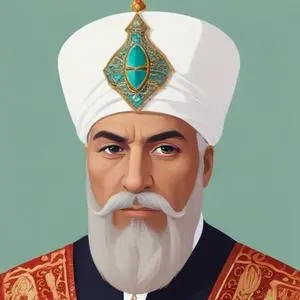
The Ottoman sultan who conquered Constantinople, ending the Byzantine Empire, and expanded Ottoman territories, shaping the modern Middle East and Europe. He's known for his military prowess and administrative reforms.
Mehmed the Conqueror, also known as Mehmed II, was the Ottoman Sultan who brought an end to the Byzantine Empire with the conquest of Constantinople in 1453, a feat that catapulted him to eternal glory. This pivotal moment in history not only cemented Mehmed's reputation as a military genius but also earned him the respect and awe of his contemporaries, who hailed him as a heroic figure.
Born on March 30, 1432, in Edirne, Ottoman Empire, Mehmed was the son of Sultan Murad II and Helena Dragaš. From a young age, Mehmed was groomed for greatness, receiving an education that emphasized literature, philosophy, and the arts. However, it was his military prowess that would ultimately define his reign.
Mehmed's ascension to the throne was marked by a series of campaigns aimed at expanding the Ottoman Empire's borders. In 1453, he laid siege to Constantinople, the capital of the Byzantine Empire, and after a grueling 53-day battle, the city fell to his forces. This victory solidified Mehmed's position as a master strategist and earned him the title "The Conqueror."
Despite his reputation as a ruthless conqueror, Mehmed was a patron of the arts and sciences, commissioning numerous architectural projects, including the construction of the Topkapi Palace in Istanbul. He also encouraged the translation of Greek and Roman texts, which helped to spread knowledge throughout the empire.
Mehmed's love for learning was reflected in his court, where scholars, poets, and artists from across the Islamic world gathered to share their knowledge and creativity. The sultan's fascination with philosophy led him to correspond with the Italian humanist, Giovanni Aurispa, who introduced him to the works of classical authors such as Plato and Aristotle.
Mehmed's personal life was marked by intrigue and tragedy. His relationships with his family members were complicated, and he was known to have ordered the execution of several relatives who threatened his power. In 1481, Mehmed died suddenly, allegedly from a heart attack, while preparing to launch a campaign against the Kingdom of Hungary.
The legacy of Mehmed the Conqueror is complex and multifaceted. While his military campaigns brought him immense power and glory, they also resulted in the displacement and destruction of countless lives. Nevertheless, his cultural achievements and patronage of the arts have had a lasting impact on the development of Ottoman culture and beyond.
"The people think of wealth and power as the greatest fate, but in this world a spell is cast, and everything is uncertain."
"The throne is a mighty burden, and its occupant is the target of a thousand arrows."
Mehmed's conquest of Constantinople marked the end of the Byzantine Empire and the beginning of a new era in Ottoman history. His military campaigns expanded the empire's borders, paving the way for the Ottoman Empire's rise as a dominant world power.
Today, Mehmed the Conqueror is remembered as a symbol of Ottoman grandeur, and his legacy continues to shape the cultural and political landscape of the modern Middle East. His name is invoked by politicians and historians alike, serving as a reminder of the power and complexity of the Ottoman Empire.
Mehmed the Conqueror's life was a testament to the complex and often contradictory nature of human ambition. While his military campaigns brought him great power and glory, they also resulted in unimaginable destruction and suffering. As we reflect on his legacy, we are reminded of the importance of balancing power with compassion and wisdom.
Born in 1494
Ruling the Ottoman Empire at its peak, he expanded its borders, conquered Belgrade, and laid siege to Vienna, earning a reputation as a brilliant military strategist and statesman. He also codified laws and reformed the empire's administration.
Born in 1447
The Ottoman Empire's eighth ruler, known for his military campaigns, administrative reforms, and cultural patronage, which led to a golden age of Ottoman architecture and art. He also oversaw the expulsion of Jews from Spain, offering them refuge in the Ottoman Empire.
Born in 1761
Reformed the Ottoman Empire's military and administration, introducing Western-style reforms to modernize the state. Known for his efforts to centralize power and reduce corruption.
Born in 1326
The founder of the Ottoman Empire's expansionist era, known for conquering much of the Balkans and establishing the Ottoman state as a dominant power in the region.
Born in 1881
Founder of modern Turkey, leading the country's transition from the Ottoman Empire to a secular, democratic nation, and implementing sweeping reforms in education, law, and women's rights.
