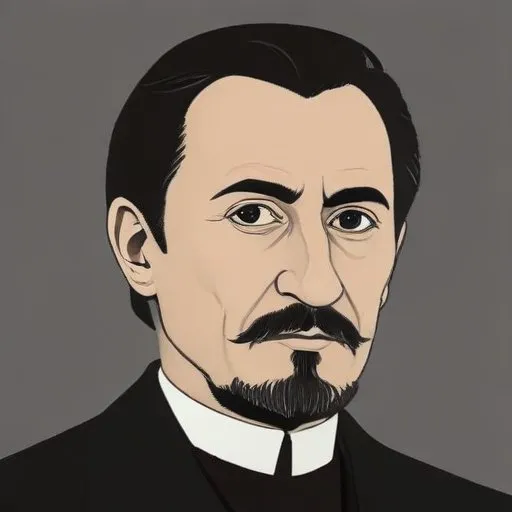
Mendele Mocher Sforim: The Father of Modern Yiddish Literature
A Pioneer in Jewish Literature
Mendele Mocher Sforim, born Sholem Yankev Abramovich, was a renowned Jewish author and one of the founders of modern Yiddish and Hebrew literature. He is credited with creating a new kind of Jewish literature that was both accessible and relevant to the common people, earning him the title "the grandfather of Yiddish literature."
Youth and Early Education
Born on January 2, 1836, in Kapyl, Minsk Governorate, Russian Empire, Mendele grew up in a poor Lithuanian Jewish family. His father, Chaim Moyshe Broyde, passed away shortly after Mendele's bar mitzvah, leaving him to fend for himself. He studied in yeshiva in Slutsk and Vilna until he was 17, during which time he was a dayboarder under the system of Tegessen, barely scraping by, and often hungry.
Extensive Travels and Inspirations
Mendele traveled extensively around Belarus, Ukraine, and Lithuania, often at the mercy of an abusive beggar named Avreml Khromoy (Russian for Avreml the Lame). This experience would later inspire the title character of one of his most famous works, "Fishke der Krumer" (Fishke the Lame). In 1854, Mendele settled in Kamianets-Podilskyi, where he met writer and poet Avrom Ber Gotlober, who introduced him to secular culture, philosophy, literature, history, Russian, and other languages.
Early Literary Career
Mendele's first article, "Letter on Education," appeared in 1857 in the first Hebrew newspaper, Hamagid. His mentor Gotlober submitted Mendele's school paper without his prior knowledge, launching his literary career. In Berdichev, where he lived from 1858 to 1869, he began to publish fiction in both Hebrew and Yiddish. However, his satire offended the local powers, and he was forced to leave Berdichev.
Training as a Rabbi and Literary Success
Mendele trained as a rabbi at the relatively theologically liberal, government-sponsored rabbinical school in Zhitomir, where he lived from 1869 to 1881. During this time, he became the head of the traditional school Talmud Torah and continued to publish his works, gaining popularity and recognition.
Major Works and Contributions
Mendele's literary contributions are immense, with some of his most notable works including:
- "Fishke der Krumer" (Fishke the Lame), a novel that explores the struggles of Jewish life in Eastern Europe
- "Dos Klein Mendele" (The Little Mendele), a collection of short stories that critiqued Jewish society
- "Di Kliatshe" (The Mare), a novel that satirized the Jewish intelligentsia
Legacy and Impact
Mendele Mocher Sforim's work had a profound impact on Jewish literature and culture. He is credited with creating a new kind of Jewish literature that was both accessible and relevant to the common people. His works continue to be studied and appreciated today, and his legacy has inspired generations of Jewish writers and thinkers.
Personal Life and Milestones
Mendele married in 1860 and had seven children. He died on December 8, 1917, in Odessa, leaving behind a rich literary legacy.
Trivia and Fun Facts
- Mendele's name was variously transliterated as Moykher, Sfarim, Seforim, etc.
- He was a prolific writer, publishing over 20 novels and numerous short stories and essays
- Mendele's works were often critical of Jewish society, leading to controversy and criticism during his lifetime
Mendele Mocher Sforim's life and work are a testament to the power of literature to shape culture and inspire change. His contributions to Jewish literature continue to be felt today, and his legacy will endure for generations to come.