


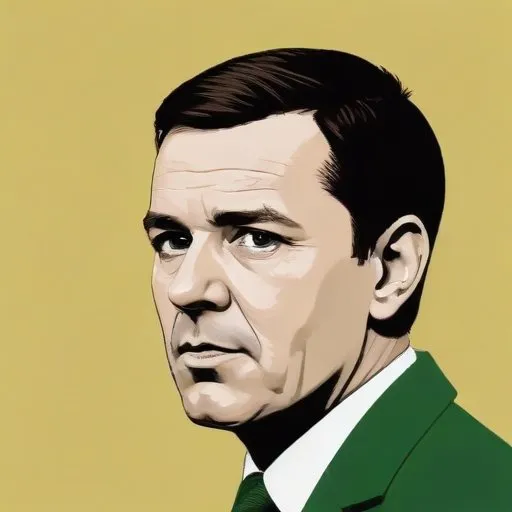
An Irish-Australian politician who served as a member of the Victorian Legislative Assembly and was a key figure in the development of Melbourne's infrastructure, particularly its tramway system.
Michael Patrick Considine was a prominent figure in Australian politics, known for his unwavering dedication to the labour movement and his unapologetic stance on social justice. As a member of the Australian Labor Party (ALP) and later the Socialist Labor Party, Considine's political career was marked by controversy, conviction, and a passion for creating change.
Born on January 26, 1885, in County Mayo, Ireland, Considine immigrated to New South Wales, Australia, with his mother in 1890. Growing up in a working-class family, Considine was exposed to the struggles of the labour movement from a young age. He became involved in trade unionism, participating in the 1908 tramway worker strike and eventually joining the Socialist Federation of Australia.
Considine's political career gained momentum during World War I, when he served as president of the Amalgamated Miners Association. His outspoken support for unions and his Marxist ideologies led to his election to the House of Representatives seat of Barrier in 1917, representing the Labor Party. However, his unconventional views and actions soon put him at odds with his party, leading to his resignation in 1919.
Undeterred, Considine ran as an independent candidate and won the seat of Barrier in 1919. The following year, he joined the Socialist Labor Party, further solidifying his reputation as a radical thinker. His unapologetic stance on issues like the Russian Revolution and criticism of the government's handling of the Kolchak forces in Russia earned him both admiration and scorn.
Considine's career was not without controversy. He was sentenced to six months in gaol in 1910 for demonstrating against the government, and later suspended from the House of Representatives for his outspoken views. Despite these setbacks, Considine's unwavering commitment to the labour movement and social justice left an indelible mark on Australian politics.
In 1918, Considine married Bessie Washington, with whom he shared a deep commitment to socialist ideals. The couple's personal life was marked by a sense of community and camaraderie, reflecting Considine's belief in the power of collective action.
Michael Considine's legacy extends far beyond his own political career. His unwavering dedication to the labour movement and social justice has inspired generations of activists, unionists, and politicians. His unapologetic stance on issues like class inequality and government accountability continues to resonate with Australians today.
Michael Considine's remarkable life serves as a testament to the power of conviction and the importance of standing up for one's beliefs, even in the face of adversity.
Born in 1815
A pioneering figure in Australian politics, instrumental in shaping the country's federation and unity, known for his tireless advocacy for a unified Australia.
Born in 1820
The 6th Premier of New South Wales, a pioneering leader who played a crucial role in shaping the Australian state's early development, particularly in education and infrastructure.
Born in 1818
The 4th Premier of New South Wales, a key figure in Australian politics, known for his role in shaping the country's early development and infrastructure. He played a crucial part in establishing the colony's education system.
62 Years Old
South Korean-American football player who played as a midfielder for the South Korea national team and various clubs, including the LA Galaxy. He's known for his speed and agility on the field.
Born in 1860
The 6th Prime Minister of Australia, a key figure in the country's early 20th-century politics, known for his role in shaping Australia's economy and foreign policy. He played a crucial part in Australia's transition from a British colony to an independent nation.
