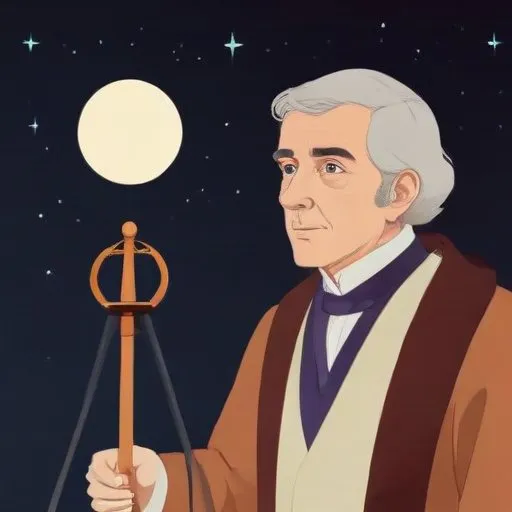
Nathaniel Bliss

Nathaniel Bliss

Nathaniel Bliss was born on November 28th, 1700

Full Name: Nathaniel Bliss
Birth Year: 1700
Place of Birth: Bisley, Gloucestershire
Profession: Astronomer and mathematician
Notable Work: Astronomical tables
Award: Copley Medal in 1735
Royal Society: Fellow of the Royal Society
Death Year: 1764

English astronomer and mathematician who made significant contributions to astronomy, particularly in the field of stellar astronomy, and served as the fourth Astronomer Royal from 1762 to 1764.

Timeline
1700
Birth of Nathaniel Bliss
Nathaniel Bliss was born in Oxford, England, to a family of mathematicians and astronomers.
1724
Becomes the Savilian Professor of Geometry
Bliss became the Savilian Professor of Geometry at Oxford University, succeeding Edmond Halley.
1742
Astronomer Royal
Bliss was appointed as the Astronomer Royal, a position he held until his death in 1764.
1762
Dies in Oxford
Nathaniel Bliss died on November 2, 1762, leaving behind a legacy as a prominent English astronomer and mathematician.
Nathaniel Bliss

Nathaniel Bliss Quiz

Nathaniel Bliss is notable for his contributions to which field of astronomy?

Score: 0/5
FAQ
What were Nathaniel Blisss contributions to astronomy?
Bliss made significant contributions to astronomy, including the discovery of a comet in 1718 and the measurement of the lunar distance from the Earth. He was also a fellow of the Royal Society.
How did Nathaniel Blisss work influence the development of navigation?
Blisss work on lunar distances and astronomical tables improved the accuracy of navigation and facilitated the calculation of longitude at sea.
What was Nathaniel Blisss role in the Royal Observatory at Greenwich?
Bliss served as the Astronomer Royal at the Royal Observatory at Greenwich from 1722 to 1742, succeeding Edmond Halley. He oversaw the collection of astronomical data and made significant improvements to the observatorys instruments and facilities.
How did Nathaniel Blisss research on comets impact scientific understanding?
Blisss observations and calculations on cometary orbits provided valuable insights into the nature of comets and their paths. His work helped to establish comets as a legitimate area of scientific study.
What was Nathaniel Blisss legacy in the history of science?
Blisss legacy is marked by his contributions to astronomy, navigation, and the development of scientific instruments. He played a significant role in the advancement of scientific knowledge during the 18th century.

Related People:

Edmond Halley

Born in 1656

Predicted celestial events, including the return of a comet that bears his name, and made significant contributions to navigation, astronomy, and mathematics.

John Flamsteed

Born in 1646

England's first Astronomer Royal, mapping the stars and creating a catalog of celestial bodies, laying the foundation for modern astronomy.

William Herschel

Born in 1738

A pioneering astronomer and musician who discovered Uranus and two of its moons, and also composed symphonies and concertos.

Caroline Herschel

Born in 1750

First female astronomer to receive a salary, discovered several comets and double stars, and assisted her brother William in his astronomical observations.

John Couch Adams

Born in 1819

Predicted the existence and location of Neptune, a previously unknown planet, using mathematical calculations, and made significant contributions to the field of astronomy.