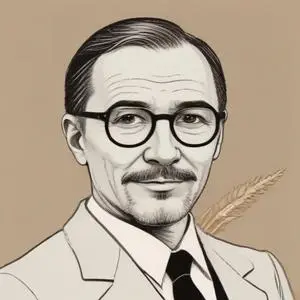
Nikolai Vavilov

Nikolai Vavilov

Nikolai Vavilov was born on November 25th, 1887

Full Name: Nikolai Ivanovich Vavilov
Place of Birth: Moscow, Russia
Profession: Botanist and geneticist
Nationality: Russian
Research: Genetics and botany
Death Date: January 26, 1943
Known For: Plant genetics
Influenced: Soviet agricultural science

A renowned botanist and geneticist who discovered and described hundreds of plant species, and developed the theory of the centers of origin of cultivated plants.

Timeline
1887
Born in Moscow
Nikolai Vavilov was born in Moscow, Russia. He would go on to become a prominent botanist and geneticist.
1917
Conducted Expedition to Persia
Vavilov conducted an expedition to Persia (modern-day Iran), where he collected and studied plant specimens.
1920
Founded the Institute of Plant Industry
Vavilov founded the Institute of Plant Industry in Leningrad, which aimed to study and improve crop yields in the Soviet Union.
1940
Arrested by Soviet Authorities
Vavilov was arrested by Soviet authorities on charges of sabotage and espionage. He was eventually sentenced to death.
1943
Died in Prison
Nikolai Vavilov died in prison in 1943, at the age of 55. His work on genetics and botany was later recognized and celebrated.
Nikolai Vavilov

Nikolai Vavilov Quiz

Nikolai Vavilov is known for developing the theory of the

Score: 0/5
FAQ
Who was Nikolai Vavilov?
Nikolai Vavilov was a Russian botanist and geneticist who made significant contributions to the fields of plant genetics, evolutionary biology, and agricultural science.
What were Nikolai Vavilovs major contributions to science?
Nikolai Vavilovs major contributions to science include his work on plant breeding, genetics, and evolutionary biology. He is also known for his discovery of the Vavilovs law of homologous series and his contributions to the development of agricultural science in the Soviet Union.
What was Nikolai Vavilovs role in the development of Soviet agriculture?
Nikolai Vavilov played a key role in the development of Soviet agriculture, working to improve crop yields, develop new varieties of crops, and promote sustainable agricultural practices. He was also a strong advocate for the importance of genetic research in agriculture.
What was Nikolai Vavilovs impact on the field of genetics?
Nikolai Vavilovs impact on the field of genetics has been significant, contributing to our understanding of plant genetics, evolutionary biology, and the importance of genetic diversity in agriculture. His work has also influenced the development of modern genetic research.
What is Nikolai Vavilovs legacy in science today?
Nikolai Vavilovs legacy in science today is one of innovation, discovery, and service to humanity. He is remembered as a pioneer in the fields of genetics and agricultural science, and his work continues to inspire new generations of scientists and researchers.

Related People:

Gregor Mendel

Born in 1822

An Austrian monk who pioneered genetics by experimenting with pea plants, discovering the fundamental laws of heredity, and laying the foundation for modern genetics.

Charles Darwin

Born in 1809

Developed the theory of evolution through natural selection, revolutionizing our understanding of life on Earth. This groundbreaking idea transformed the fields of biology, ecology, and beyond.

Jean-Baptiste Lamarck

Born in 1744

A French soldier, biologist, and academic who developed a theory of inheritance of acquired characteristics, proposing that organisms adapt to their environment and pass on those traits to their offspring.

Ernst Mayr

Born in 1904

A renowned biologist and ornithologist who pioneered the modern synthesis of evolutionary biology, shaping our understanding of species and their diversity.

Theodosius Dobzhansky

Born in 1900

A pioneer in evolutionary biology, he integrated genetics and evolution, revolutionizing our understanding of species adaptation and diversity. His work laid the foundation for modern evolutionary theory.

Sewall Wright

Born in 1889

Developed the modern concept of genetic drift, a fundamental principle in population genetics, and pioneered the use of statistical methods in evolutionary biology.

Ronald Fisher

Born in 1890

A pioneer in statistics and genetics, he developed techniques for data analysis and laid the foundations for modern evolutionary theory. His work has far-reaching implications in fields like medicine, agriculture, and social sciences.

Hugo de Vries

Born in 1848

A Dutch pioneer in genetics, he discovered mutations and introduced the concept of genes, laying the foundation for modern genetics. His work influenced the development of evolutionary theory.