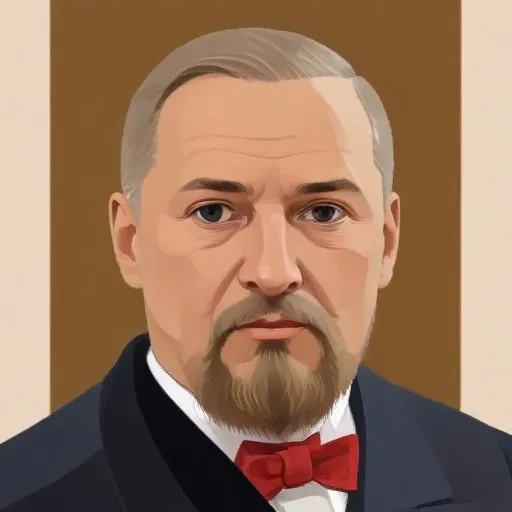
Nikolay Yakovlevich Sonin

Nikolay Yakovlevich Sonin

Nikolay Yakovlevich Sonin was born on February 22nd, 1849

Full Name: Nikolay Yakovlevich Sonin
Place of Birth: Tula, Russia
Profession: Mathematician and Academic
Field of Study: Number Theory and Algebra
University: University of Moscow
Students: Andrey Kolmogorov and others
Honors: Honorary Doctor of Science
Notable Works: Theory of Prime Numbers

A prominent mathematician and academic who made significant contributions to the fields of mathematics, particularly in the areas of differential equations and number theory, and was a prominent educator and administrator in Russia.

Timeline
1849
Birth of Nikolay Sonin
Nikolay Sonin was born on February 22, 1849, in Bytsevo, Russia. He would go on to become a renowned mathematician and academic.
1877
Earned Ph.D. in Mathematics
Sonin earned his Ph.D. in mathematics from the University of Moscow, where he later became a professor.
1894
Elected to the Russian Academy of Sciences
Sonin was elected to the Russian Academy of Sciences, one of the highest honors in Russian science.
1915
Published influential math textbooks
Sonin published several influential mathematics textbooks, which became standard references for Russian students.
1920
Death of Nikolay Sonin
Nikolay Sonin died on February 27, 1920, at the age of 71, leaving behind a legacy as a leading Russian mathematician.
Nikolay Yakovlevich Sonin

Nikolay Yakovlevich Sonin Quiz

Nikolay Yakovlevich Sonin's contributions to mathematics were primarily in the areas of

Score: 0/5
FAQ
What were Nikolay Yakovlevich Sonins contributions to Russian mathematics?
Nikolay Yakovlevich Sonin was a prominent Russian mathematician who made significant contributions to the fields of differential equations, integral equations, and functional analysis.
What was Nikolay Yakovlevich Sonins role in Russian academia?
Nikolay Yakovlevich Sonin played a vital role in Russian academia, serving as a professor at Moscow State University and publishing numerous papers on mathematics and physics.
What awards did Nikolay Yakovlevich Sonin receive?
Nikolay Yakovlevich Sonin received several awards for his outstanding contributions to Russian mathematics, including the Lomonosov Prize.
What was Nikolay Yakovlevich Sonins research focus?
Nikolay Yakovlevich Sonins research focused on differential equations, particularly on the theory of orthogonal functions and their applications in physics.
What is Nikolay Yakovlevich Sonins legacy in Russian mathematics?
Nikolay Yakovlevich Sonins legacy in Russian mathematics is marked by his groundbreaking contributions to the development of functional analysis and his influence on generations of Russian mathematicians.

Related People:

Andrey Markov

Born in 1856

Developed the theory of Markov chains, a mathematical system that undergoes transitions from one state to another, and is widely used in computer science, biology, and economics.

Sofia Kovalevskaya

Born in 1850

A trailblazing mathematician and physicist who made groundbreaking contributions to differential equations, integral calculus, and mechanics, paving the way for future generations of women in STEM fields.

Henri Poincaré

Born in 1854

A pioneer in mathematics and physics, he laid the foundations for modern chaos theory, topology, and relativity, making groundbreaking contributions to our understanding of space and time.

Born in 1871

A French mathematician and politician who made significant contributions to probability theory, measure theory, and topology, and served as a minister in the French government.

David Hilbert

Born in 1862

A renowned mathematician and academic who developed infinite-dimensional vector spaces and laid the foundation for quantum mechanics and relativity. He's also famous for his 23 unsolved math problems that shaped 20th-century mathematics.

Felix Klein

Born in 1849

A pioneer in geometry and group theory, known for developing the Erlangen program, which unified various geometries under a single framework. His work laid foundations for modern algebraic geometry and topology.

Pierre-Simon Laplace

Born in 1749

Developed nebular hypothesis of the origin of the solar system and formulated Laplace's equation, a fundamental concept in mathematics and physics. He's considered the founder of celestial mechanics.

Carl Friedrich Gauss

Born in 1777

A pioneer in mathematics and physics, he made major contributions to number theory, algebra, and electromagnetism, shaping our understanding of the natural world.