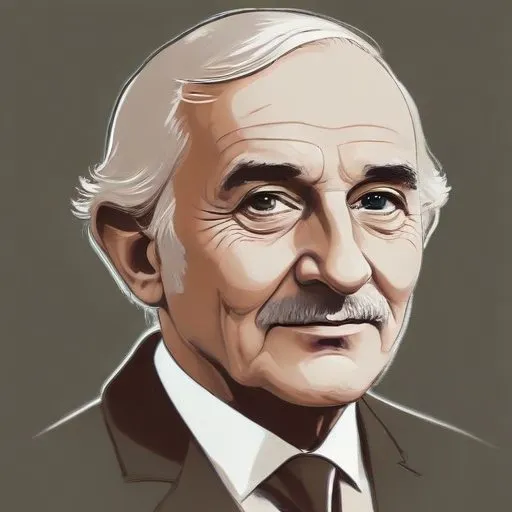
Ours-Pierre-Armand Petit-Dufrénoy

Ours-Pierre-Armand Petit-Dufrénoy

Ours-Pierre-Armand Petit-Dufrénoy was born on September 5th, 1792

Full Name: Ours-Pierre-Armand Petit-Dufrénoy
Profession: Geologist and Mineralogist
Nationality: French
Field of Work: Geology and Mineralogy
Place of Birth: Savoy, France
Occupation: Scientist
Area of Expertise: Mineralogy
Notable Work: Study of French geology

French geologist and mineralogist who pioneered the field of geological cartography, creating the first geological maps of France. He's also known for his work on mineral classification and crystallography.

Timeline
1792
Birth
Ours-Pierre-Armand Petit-Dufrénoy was born on September 5th in France.
1815
Geological Exploration
Petit-Dufrénoy began his geological exploration of the French Alps, leading to significant discoveries.
1824
Mineralogical Findings
He published his findings on the mineralogy of the Alps, including the discovery of new minerals.
1833
Geological Mapping
Petit-Dufrénoy began creating geological maps of France, which became a standard reference.
1850
Académie des Sciences
He was elected to the Académie des Sciences, recognizing his contributions to geology and mineralogy.
Ours-Pierre-Armand Petit-Dufrénoy

Ours-Pierre-Armand Petit-Dufrénoy Quiz

What field of study did Ours-Pierre-Armand Petit-Dufrénoy pioneer?

Score: 0/5
FAQ
What were Ours-Pierre-Armand Petit-Dufrénoys contributions to the field of geology?
Petit-Dufrénoy was a French geologist and mineralogist who made significant contributions to the field of geology through his research on mineralogy and petrography. He was one of the first scientists to study the geological structure of the Alps.
What is Ours-Pierre-Armand Petit-Dufrénoys most famous discovery?
Petit-Dufrénoys most famous discovery is the mineral DUfrénoyite, which he discovered in 1845. It is a rare mineral that is found in only a few locations around the world.
How did Ours-Pierre-Armand Petit-Dufrénoys work influence the development of geology as a field?
Petit-Dufrénoys work influenced the development of geology by providing a foundation for future research in the field. His research on mineralogy and petrography helped to establish geology as a distinct scientific discipline.
What was Ours-Pierre-Armand Petit-Dufrénoys approach to scientific research?
Petit-Dufrénoys approach to scientific research was characterized by his emphasis on careful observation and detailed description. He was meticulous in his research and was known for his ability to identify and classify minerals with precision.
How is Ours-Pierre-Armand Petit-Dufrénoy remembered today?
Petit-Dufrénoy is remembered today as a pioneering geologist and mineralogist who made significant contributions to our understanding of the natural world. He is celebrated for his groundbreaking research and his legacy continues to inspire scientists today.

Related People:

Jean-Baptiste Lamarck

Born in 1744

A French soldier, biologist, and academic who developed a theory of inheritance of acquired characteristics, proposing that organisms adapt to their environment and pass on those traits to their offspring.

Georges Cuvier

Born in 1769

Founded the field of comparative anatomy, establishing extinction as a fact and creating a framework for understanding the natural world through fossil records.

Pierre-Simon Laplace

Born in 1749

Developed nebular hypothesis of the origin of the solar system and formulated Laplace's equation, a fundamental concept in mathematics and physics. He's considered the founder of celestial mechanics.

Antoine Lavoisier

Born in 1743

Father of modern chemistry, discovered oxygen, and developed a systematic method of chemical nomenclature. He laid the foundation for modern chemistry and paved the way for future scientific discoveries.

Louis Nicolas Vauquelin

Born in 1763

Discovered chromium and isolated the first sample of beryllium, contributing significantly to the development of modern chemistry. His work paved the way for future discoveries in the field.

André-Marie Ampère

Born in 1775

A pioneer in the field of electromagnetism, he formulated fundamental laws that describe the relationship between electric currents and magnetic fields. His work laid the foundation for many modern technologies, including electric motors and generators.