


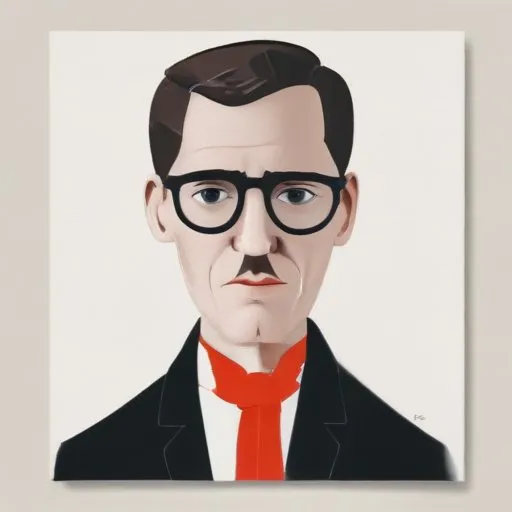
A French painter renowned for his vibrant, expressive depictions of African wildlife and landscapes, which captivated the art world with their exotic beauty.
Known for his vibrant and intricate depictions of African wildlife, Paul Jouve was a French painter, sculptor, and illustrator who left an indelible mark on the world of art. His works, often characterized by their bold lines, expressive brushstrokes, and mesmerizing colors, transport viewers to the heart of the African savannah.
Born in Marlotte, Seine-et-Marne, France on March 16, 1878, Jouve grew up surrounded by the artistic universe of his father's ceramist workshop on Boulevard Saint Jacques in Paris. It was here that he developed his passion for drawing, encouraged by his father and pampered by his young mother, who dreamed of making a teacher of him.
Jouve's early fascination with the big cats was ignited by his visits to the Jardin des Plantes, where he would spend hours drawing and observing the majestic creatures. This passion would later become the hallmark of his artistic career, earning him recognition and accolades from around the world.
In 1907, Jouve became the first recipient of the prestigious Prix Abdel Tif, awarded to him by the General Government of Algeria. He would later receive the Prix d'Indochine in 1921, further solidifying his position as a master of his craft.
In 1922, Jouve embarked on a life-changing journey to the Far East, representing France as a painter on a mission. His eleven-month odyssey took him to Indochina, China, Ceylon, and India, culminating in a three-month stay in the ancient city of Angkor. The experiences and inspiration garnered during this journey would have a profound impact on his art, infusing it with a new level of depth and nuance.
Jouve's work extended beyond the realm of fine art, as he was commissioned by the Contemporary Book Society to illustrate Rudyard Kipling's beloved Jungle Book. Although publication was delayed until 1919, the project marked a significant milestone in Jouve's career, showcasing his versatility and ability to adapt to different mediums.
Paul Jouve's artistic contributions continue to captivate audiences today, offering a glimpse into the beauty and majesty of the African wilderness. Through his work, he has inspired generations of artists, naturalists, and enthusiasts alike, leaving behind a rich cultural heritage that will endure for centuries to come.
"The savannah is not just a backdrop for my art, but a living, breathing entity that pulsates with life and energy. It is a reminder of the beauty and fragility of our natural world."
Born in 1881
A pioneering artist who transformed modern art with pioneering Cubist works, creating a new visual language that continues to inspire and influence art, design, and culture.
Born in 1869
A pioneering artist who revolutionized modern art with bold, expressive, and colorful works that blurred the lines between painting and sculpture, creating a new language of form and color.
Born in 1893
A renowned Spanish artist, famous for his vibrant, dreamlike paintings and sculptures that blended abstraction and surrealism, creating a unique visual language. His works often featured bold colors, biomorphic forms, and a sense of playfulness.
Born in 1904
A renowned surrealist master of bizarre, dream-like paintings and sculptures that blur reality and fantasy, known for iconic works like "The Persistence of Memory" and "The Elephants".
Born in 1898
A Belgian surrealist painter who challenged perceptions by depicting everyday objects in unexpected contexts, creating thought-provoking and witty visual paradoxes.
Born in 1887
A dreamlike painter and poet who blended fantasy and reality, creating vibrant, emotive works that explored Jewish culture and the human experience.
Born in 1882
A pioneer of Cubism, creating fragmented forms and multiple perspectives in art, revolutionizing modern art movements.
Born in 1884
An Italian artist famous for elongated, emotive portraits and nudes that blended primitivism with cubism, capturing the essence of his subjects with expressive simplicity.
