


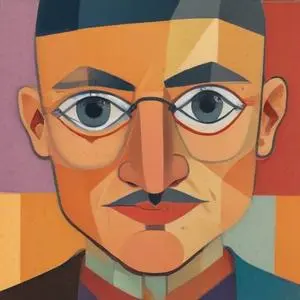
A Swiss-German artist and educator who blended fantasy and reality in his vibrant, whimsical paintings, exploring the emotional and expressive qualities of color. His unique style has inspired generations of artists.
Paul Klee, a Swiss-born German artist, is renowned for his highly individualistic style that seamlessly merged expressionism, cubism, and surrealism, leaving an indelible mark on the world of modern art. His pioneering work in color theory, documented in his seminal lectures and writings, has been hailed as a beacon of inspiration, akin to Leonardo da Vinci's A Treatise on Painting during the Renaissance.
Born on December 18, 1879, in Mnchenbuchsee, Switzerland, Klee was the second child of German music teacher Hans Wilhelm Klee and Swiss singer Ida Marie Klee. His early life was steeped in music, with his parents encouraging and inspiring him to develop his musical skills. In 1886, he began receiving violin classes at the Municipal Music School, and by 1890, he was attending primary school in Bern.
Klee's artistic inclinations became apparent during his teenage years, and by 1898, he had begun to hone his skills as an illustrator. His passion for art led him to pursue a degree in fine arts at the Academy of Fine Arts in Munich, where he studied from 1898 to 1901. It was during this period that he became acquainted with the works of avant-garde artists, which would later influence his unique style.
In 1921, Klee joined the prestigious Bauhaus school in Germany as a teacher, alongside his colleague and fellow artist, Wassily Kandinsky. This partnership would prove to be instrumental in shaping the future of modern art. His lectures on color theory and design, later published as the Paul Klee Notebooks, have become a seminal work in the field.
Klee's artistic oeuvre is characterized by a distinctive blend of whimsy, humor, and musicality. Some of his notable works include:
Klee's artistic philosophy was deeply rooted in his belief that art should be a reflection of the artist's inner world. He advocated for the importance of intuition and imagination in the creative process, saying, "Art does not reproduce the visible; rather, it makes visible."
Klee's life was marked by personal struggles, including his mother's passing in 1921 and his own diagnosis with scleroderma in 1935. Despite these challenges, he continued to create, and his art became a testament to his resilience and determination.
Klee's innovative approach to art has inspired generations of artists, designers, and musicians. His work has had a profound impact on the development of modern art, influencing movements such as abstract expressionism and pop art.
Paul Klee's remarkable body of work has left an indelible mark on the world of modern art. His contributions to color theory, design, and art education have cemented his place as one of the most important artists of the 20th century. Despite the challenges he faced during his lifetime, Klee's art remains a testament to the power of creativity and imagination.
Born in 1866
A pioneer of abstract art, creating vibrant, expressive works that explored the emotional and spiritual properties of color, and wrote extensively on art theory.
Born in 1880
A German soldier-turned-painter who pioneered Expressionism, capturing the emotional essence of animals and landscapes in vibrant, abstracted forms. His work continues to inspire artists and art lovers alike.
Born in 1885
A pioneer of Orphism, a style of abstract art that emphasizes geometric shapes and vibrant colors, creating dynamic and expressive works that explore the emotional potential of color. 42
Born in 1869
A pioneering artist who revolutionized modern art with bold, expressive, and colorful works that blurred the lines between painting and sculpture, creating a new language of form and color.
Born in 1881
A pioneering artist who transformed modern art with pioneering Cubist works, creating a new visual language that continues to inspire and influence art, design, and culture.
Born in 1904
A renowned surrealist master of bizarre, dream-like paintings and sculptures that blur reality and fantasy, known for iconic works like "The Persistence of Memory" and "The Elephants".
Born in 1887
A dreamlike painter and poet who blended fantasy and reality, creating vibrant, emotive works that explored Jewish culture and the human experience.
Born in 1893
A renowned Spanish artist, famous for his vibrant, dreamlike paintings and sculptures that blended abstraction and surrealism, creating a unique visual language. His works often featured bold colors, biomorphic forms, and a sense of playfulness.
