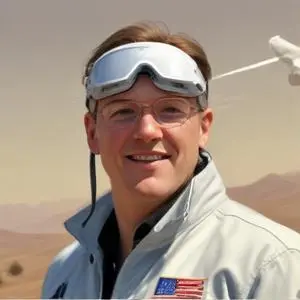
Paul MacCready: The Visionary Aeronautical Engineer Who Defied Gravity
The Man Behind the Human-Powered Aircraft
Paul MacCready, a renowned American aeronautical engineer, is best known for designing the world's first human-powered aircraft, which won the prestigious Kremer prize. His innovative design not only pushed the boundaries of aviation but also inspired a generation of engineers and inventors to think beyond the conventional.
Early Life and Education
Born on September 25, 1925, in New Haven, Connecticut, MacCready came from a medical family. Despite being the smallest kid in his class, he found his calling in model airplanes, winning a national contest at the tender age of 15. This early success sparked a passion for innovation that would stay with him throughout his life. MacCready graduated from Hopkins School in 1943 and went on to train as a US Navy pilot before the end of World War II. He then pursued higher education, earning a BS in physics from Yale University in 1947, an MS in physics from Caltech in 1948, and a PhD in aeronautics from Caltech in 1952.
Career Highlights and Major Works
MacCready's professional journey began in 1951 when he founded Meteorology Research Inc., a company dedicated to atmospheric research. As a graduate student, he explored cloud seeding and was an early pioneer in using aircraft to study meteorological phenomena. His work in this field laid the foundation for his future innovations.
- In 1956, MacCready became the first American pilot to win the World Soaring Championship.
- He invented a device that helped pilots determine the optimal speed to fly a glider, revolutionizing the sport.
- In the 1970s, MacCready founded AeroVironment, a company focused on developing more efficient transportation vehicles.
- He designed the Gossamer Albatross, a human-powered aircraft that crossed the English Channel in 1977, winning the Kremer prize.
MacCready's work was driven by his passion for creating more efficient transportation systems. He believed that by minimizing energy consumption, we could reduce our impact on the environment. This philosophy led him to explore alternative energy sources and sustainable designs.
Personal Milestones and Key Life Events
Throughout his life, MacCready was driven by his curiosity and creativity. He was an avid glider pilot and won several championships, including the Richard C. du Pont Memorial Trophy three times.
Influence on Modern Society
MacCready's innovative designs and sustainable approach to transportation have inspired generations of engineers, inventors, and environmentalists. His work has paved the way for the development of electric and hybrid vehicles, as well as more efficient aircraft designs.
Legacy and Historical Context
Paul MacCready's legacy extends far beyond his impressive list of achievements. He was a true pioneer, whose work continues to shape the aviation and environmental industries. As we move forward in an era of rising environmental concerns, MacCready's vision and innovative spirit serve as a beacon of hope, inspiring us to think creatively and strive for a more sustainable future.
Trivia and Fun Facts
- MacCready was an avid reader and enjoyed science fiction novels.
- He was a strong advocate for alternative energy sources and sustainable living.
- MacCready's love for gliding led him to set several world records throughout his career.
Awards and Honors
MacCready received numerous awards and honors for his contributions to aeronautics and sustainable transportation, including the National Medal of Science, the Wright Brothers Master Pilot Award, and the International Air & Space Hall of Fame.
Conclusion
Paul MacCready's remarkable journey serves as a testament to the power of innovation and creativity. As we continue to face the challenges of the 21st century, his legacy reminds us of the importance of sustainable design, alternative energy sources, and the boundless potential of the human spirit.
FAQ
What is Paul MacCreadys most notable achievement in aviation?
Paul MacCreadys most notable achievement in aviation is the development of the Gossamer Albatross, a human-powered aircraft that crossed the English Channel in 1977. This pioneering achievement marked a significant milestone in aviation history.
How did Paul MacCreadys engineering background influence his work in aviation?
Paul MacCreadys engineering background influenced his work in aviation by providing him with a strong foundation in mechanics and materials science. His expertise in these areas allowed him to design and build innovative and efficient aircraft.
What was Paul MacCreadys role in the development of unmanned aerial vehicles (UAVs)?
Paul MacCready played a significant role in the development of unmanned aerial vehicles (UAVs) through his company AeroVironment. He designed and built several UAVs, including the Pointer, which was used for surveillance and reconnaissance missions.
What awards did Paul MacCready receive for his contributions to aviation?
Paul MacCready received several awards for his contributions to aviation, including the National Medal of Science, the National Air and Space Museum Trophy, and the Wright Brothers Master Pilot Award.
What was Paul MacCreadys legacy in the field of aviation?
Paul MacCreadys legacy in the field of aviation is that of a visionary and innovator who pushed the boundaries of what was thought possible. His work in human-powered flight and UAVs paved the way for future generations of aviators and engineers.