


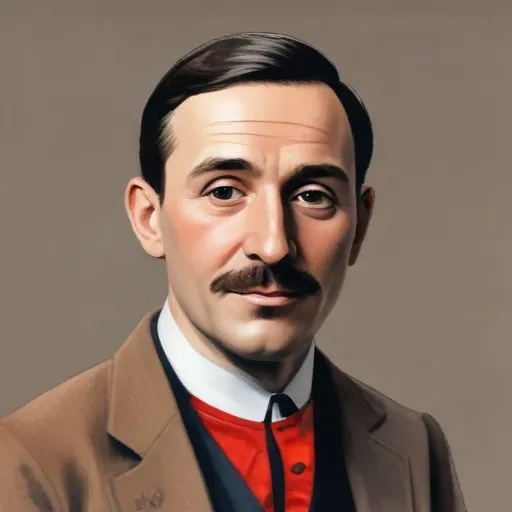
A talented artist and educator, known for his Impressionist-style paintings of everyday life and landscapes, as well as his role in establishing the Ontario College of Art.
Paul Peel, a renowned Canadian figure painter, is celebrated for being one of the first Canadian artists to receive international recognition during his lifetime. His impressive career was marked by his exceptional skill in capturing the beauty of the human form, particularly in his sentimental nudes and charming depictions of children.
Born on November 7, 1860, in London, Canada West, Peel's artistic journey began under the guidance of his father. He further honed his skills by studying with William Lees Judson and at the Pennsylvania Academy of the Fine Arts with Thomas Eakins from 1877 to 1880. This training laid the foundation for his subscription to the tonal method of rendering natural light outdoors, a technique he shared with fellow graduates of the Pennsylvania Academy of Arts and students of Eakins.
In 1881, Peel moved to Paris, France, where he studied at the École nationale supérieure des Arts Decoratifs and later enrolled in the atelier of Jean-Léon Gérôme at the École des Beaux-Arts. It was Gérôme who encouraged Peel to sketch outdoors, a habit that greatly influenced his work. Peel continued his artistic education with Jean-Joseph Benjamin-Constant in his private atelier and then with him at the Académie Julian, as well as with Henri Doucet and Jules Lefebvre from 1877 to 1890.
Peel's talent quickly gained recognition, and he exhibited his first painting at the Paris Salon in 1883, where he would continue to showcase his work regularly until 1892. His participation in the Ontario Society of Artists and the Royal Canadian Academy of Arts further solidified his reputation as a prominent Canadian artist. In 1890, he won a bronze medal at the Paris Salon for his painting After the Bath, which marked a significant milestone in his career.
Peel's paintings are characterized by their conservative quality, but some of his later works reveal his exploration of Impressionist color and light. He is particularly known for his sentimental nudes and charming depictions of children, which often captured the innocence and beauty of childhood. His brand of art became synonymous with the public's perception of him as an artist.
Paul Peel's remarkable career serves as a testament to his dedication to his craft, and his contributions to the world of art continue to be cherished and admired today.
69 Years Old
A renowned journalist and author, best known for his gripping historical fiction novels, particularly the Cicero trilogy, which brings ancient Rome to life.
Born in 1845
The 4th Prime Minister of Australia, a Scottish-Australian lawyer and politician who served from 1904 to 1905, known for his role in shaping the country's early years and contributing to its growth.
