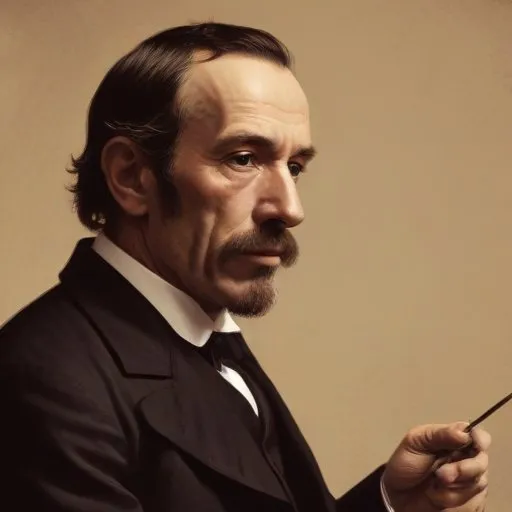
Thomas Eakins: The Master of Realism and Innovation
Thomas Eakins, a renowned American realist painter, photographer, sculptor, and fine arts educator, is widely regarded as one of the most important American artists of all time. With a career spanning over 40 years, Eakins dedicated his life to capturing the essence of Philadelphia's intellectual life through his masterful portraits and innovative use of photography.
A Life of Artistic Pursuit
Born on July 25, 1844, in Philadelphia, Pennsylvania, Eakins was the first child of Caroline Cowperthwait Eakins and Benjamin Eakins. From an early age, he demonstrated a strong inclination towards art, which was nurtured by his father, a writing master and calligraphy teacher. Eakins' talent and dedication earned him a scholarship to the Pennsylvania Academy of the Fine Arts, where he honed his skills under the tutelage of prominent artists such as Christian Schussele and Thomas Anshutz.
Portraits of Philadelphia's Elite
Eakins' most notable works are his portraits of prominent Philadelphians, capturing the city's intellectual and cultural zeitgeist. His subjects included friends, family members, and esteemed figures from the arts, sciences, medicine, and clergy. These portraits, totaling over several hundred, offer a unique glimpse into the lives of Philadelphia's elite during the late 19th and early 20th centuries.
Large-Scale Paintings: Bringing Portraits to Life
Beyond his intimate portraits, Eakins created a series of large-scale paintings that transported his subjects from the confines of the drawing room to the bustling streets, parks, rivers, and arenas of Philadelphia. These works showcased his mastery of perspective and his fascination with capturing the human form in motion, often in outdoor settings.
Innovations in Motion Photography
Eakins' fascination with the human body in motion led him to experiment with motion photography, a field in which he is now recognized as a pioneer. His work in this area paved the way for the development of modern motion picture technology.
A Legacy of Controversy and Redemption
Despite his artistic genius, Eakins faced numerous challenges during his lifetime, including behavioral and sexual scandals that tarnished his reputation and limited his success. However, since his death on June 25, 1916, Eakins has been celebrated as the strongest, most profound realist in 19th- and early 20th-century American art.
Influence on American Art
Eakins' influence on American art is immeasurable. As an educator, he taught and inspired generations of artists, including notable figures such as Henry O. Tanner and Thomas Pollock Anshutz. His commitment to realism and innovation has left an indelible mark on the art world, solidifying his place as one of America's most important artists.
Quotes and Memorable Sayings
- "I believe that all art should be based on nature, and that the study of nature is the only way to perfection."
- "Art is not made for the masses, but for the few who can appreciate it."
Legacy and Impact
Today, Eakins' work can be found in prominent museums and galleries across the United States, including the Philadelphia Museum of Art, the Metropolitan Museum of Art, and the National Gallery of Art. His contributions to the world of art, photography, and education continue to inspire generations of artists, photographers, and educators, solidifying his place as a true American master.