


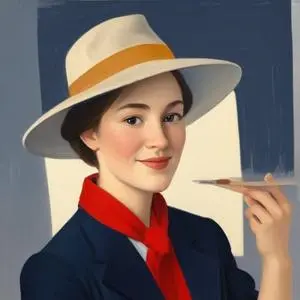
An American Impressionist painter and educator, she created intimate, tender portraits of women and children, capturing the quiet beauty of everyday life. Her artwork often explored the complexities of motherhood and femininity.
Mary Cassatt was an American painter and printmaker celebrated for her captivating depictions of the social and private lives of women, particularly the tender relationships between mothers and children. As a leading figure in the Impressionist movement, her work continues to captivate art enthusiasts with its subtle yet profound exploration of femininity and domesticity.
Mary Stevenson Cassatt was born on May 22, 1844, in Allegheny, Pennsylvania, to an upper-middle-class family. Her father, Robert Simpson Cassatt, was a successful stockbroker and land speculator, while her mother, Katherine Kelso Johnston, came from a banking family. Katherine's influence played a significant role in shaping Mary's artistic inclinations, with her friend Louisine Havemeyer later noting, "Anyone who had the privilege of knowing Mary Cassatt's mother would know at once that it was from her and her alone that Mary inherited her ability."
Cassatt's artistic journey began in Pennsylvania, where she attended the Pennsylvania Academy of Fine Arts. In 1865, she traveled to Paris to study art, eventually settling in France and befriending Edgar Degas, a prominent Impressionist artist. Cassatt's work was deeply influenced by Degas' style, and she went on to exhibit with the Impressionists in 1879. Diego Martelli, an art critic, praised her skill in capturing movement, light, and design, comparing her to Degas.
Cassatt's art is characterized by its emphasis on the private lives of women, often focusing on the emotional bonds between mothers and children. Her paintings are marked by soft, feathery brushstrokes and a subdued color palette, evoking a sense of quiet intimacy. Her subjects, typically women from the upper class, are depicted in domestic settings, engaged in everyday activities like reading, playing, or simply enjoying each other's company.
Cassatt's contributions to the art world were recognized during her lifetime. She was awarded the French Legion of Honor in 1904, and her work was exhibited at the Salon des Artistes Indépendants in 1881.
Mary Cassatt's pioneering work paved the way for future generations of female artists. Her focus on the domestic sphere and the relationships between women challenged prevailing art historical narratives, cementing her position as one of the leading figures of Impressionism.
Today, Cassatt's paintings continue to captivate audiences with their subtlety, nuance, and profound exploration of femininity. As a testament to her enduring influence, her work remains an integral part of modern art discourse, inspiring newfound appreciation for the quiet beauty of everyday life.
Born in 1834
A master of capturing the beauty of movement and everyday life, this artist is renowned for their stunning Impressionist paintings, sculptures, and illustrations of dancers, horses, and Parisian scenes.
Born in 1830
A Danish-French Impressionist painter who captured the beauty of landscapes and cityscapes with vivid colors and bold brushstrokes, influencing the development of modern art.
Born in 1841
A pioneering Impressionist artist, capturing intimate, everyday moments of women's lives in delicate, dreamy paintings. Her works often blurred the lines between domesticity and artistry.
Born in 1841
A pioneer of Impressionism, creating vibrant, intimate portraits and landscapes that capture the beauty of everyday life. His works evoke a sense of joy and warmth, celebrating the human experience.
Born in 1840
A founder of Impressionism, capturing fleeting light and color in dreamy landscapes and water scenes, revolutionizing modern art.
Born in 1839
A landscape painter who captured the essence of rural France and England through his Impressionist works, often focusing on the fleeting effects of light and atmosphere.
Born in 1839
A post-Impressionist pioneer, he's famous for his still-life compositions and landscapes that laid the groundwork for Cubism, influencing 20th-century art.
Born in 1856
A renowned portrait painter, capturing the essence of high society with his stunning watercolors and oils, leaving an indelible mark on the art world.
