


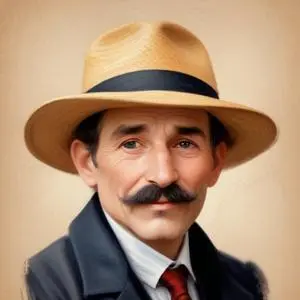
A pioneer of Impressionism, creating vibrant, intimate portraits and landscapes that capture the beauty of everyday life. His works evoke a sense of joy and warmth, celebrating the human experience.
Known for his captivating portraits of feminine sensuality and beauty, PierreAuguste Renoir was a leading painter in the development of the Impressionist style. His artworks exude a sense of warmth, intimacy, and joy, earning him the reputation as the final representative of a tradition that runs directly from Rubens to Watteau.
Renoir was born on February 25, 1841, in Limoges, Haute-Vienne, France, to a family of modest means. His father, Léonard Renoir, was a tailor who moved the family to Paris in 1844 in search of better prospects. This move proved fortunate for the young Renoir, who grew up in proximity to the Louvre and developed a natural proclivity for drawing.
Although Renoir initially showed talent for singing, his family's financial circumstances forced him to discontinue his music lessons and leave school at the age of thirteen to pursue an apprenticeship at a porcelain factory. However, his artistic talents soon became apparent, and he began taking lessons to prepare for entry into Ecole des Beaux-Arts.
In 1862, Renoir started studying art under Charles Gounod, and his early works were heavily influenced by the Romantic movement. However, it wasn't until the late 1860s and early 1870s that he developed his distinctive Impressionist style, characterized by soft, feathery brushstrokes and an emphasis on capturing the fleeting effects of light.
Renoir's breakthrough came in 1874, when he, along with Claude Monet, Camille Pissarro, and other artists, organized an exhibition that would come to be known as the first Impressionist exhibition. This marked the beginning of his rise to fame, and he went on to participate in several more Impressionist exhibitions throughout the 1870s and 1880s.
Renoir's most famous works include:
Renoir married Aline Victorine Charigot in 1890, and the couple had three sons, including the famous filmmaker Jean Renoir. Throughout his life, Renoir struggled with arthritis, which eventually forced him to adapt his painting technique to accommodate his disability.
Renoir's legacy extends far beyond his own artworks. He has inspired countless artists, including Henri Matisse, Pablo Picasso, and Salvador Dalí, and continues to be celebrated as one of the greatest painters of all time.
As Renoir once said, "I've been forty years discovering that the queen of all colors is black." This quote highlights his dedication to exploring the subtleties of color and light, as well as his humble approach to his craft.
Renoir's artworks have had a profound impact on modern society, influencing not only the development of modern art but also popular culture and fashion. His emphasis on capturing the beauty of everyday life has inspired generations of artists, designers, and photographers.
Today, Renoir's paintings continue to captivate audiences around the world, a testament to the enduring power of his art. As a master of Impressionist beauty, Renoir's legacy will forever be etched in the annals of art history.
Born in 1840
A founder of Impressionism, capturing fleeting light and color in dreamy landscapes and water scenes, revolutionizing modern art.
Born in 1830
A Danish-French Impressionist painter who captured the beauty of landscapes and cityscapes with vivid colors and bold brushstrokes, influencing the development of modern art.
Born in 1839
A post-Impressionist pioneer, he's famous for his still-life compositions and landscapes that laid the groundwork for Cubism, influencing 20th-century art.
Born in 1869
A pioneering artist who revolutionized modern art with bold, expressive, and colorful works that blurred the lines between painting and sculpture, creating a new language of form and color.
Born in 1881
A pioneering artist who transformed modern art with pioneering Cubist works, creating a new visual language that continues to inspire and influence art, design, and culture.
Born in 1844
An American Impressionist painter and educator, she created intimate, tender portraits of women and children, capturing the quiet beauty of everyday life. Her artwork often explored the complexities of motherhood and femininity.
Born in 1834
A master of capturing the beauty of movement and everyday life, this artist is renowned for their stunning Impressionist paintings, sculptures, and illustrations of dancers, horses, and Parisian scenes.
Born in 1841
A pioneering Impressionist artist, capturing intimate, everyday moments of women's lives in delicate, dreamy paintings. Her works often blurred the lines between domesticity and artistry.
