


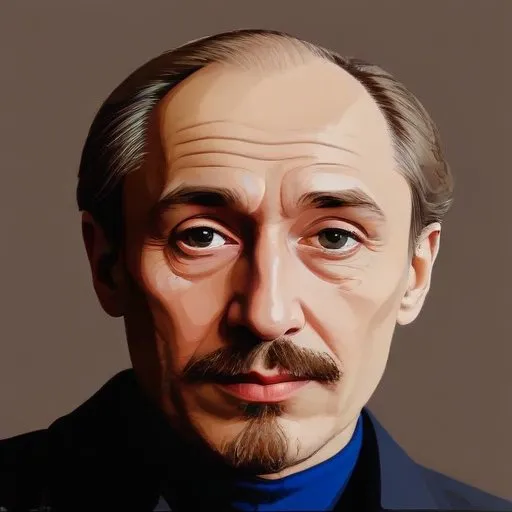
A Russian avant-garde artist who developed a unique style of abstract figurative painting, blending elements of Cubism and Futurism, and wrote poetry that explored the relationship between art and reality.
Pavel Filonov, a Russian avant-garde painter, art theorist, and poet, is renowned for formulating the principles of analytical realism, a revolutionary art movement that starkly contrasted with the prevailing Cubist trends of the early 20th century. His groundbreaking theories and artistic innovations not only influenced the Russian art scene but also left an indelible mark on the global artistic landscape.
Born on January 8, 1883, in Moscow, Filonov moved to St. Petersburg in 1897, where he received his early art training. In 1908, he enrolled in the St. Petersburg Academy of Arts, but his stay was short-lived, and he was expelled in 1910.
In 1912, Filonov penned the seminal article "The Canon and the Law," in which he articulated the core principles of analytical realism. This manifesto-like treatise rejected the surface-level geometry of Cubism, instead advocating for a more profound representation of objects through their inner essence or "soul." This radical departure from the status quo established Filonov as a visionary and a pioneer of a new artistic movement.
Filonov's creative trajectory was marked by collaborations with prominent figures of the Russian avant-garde. He was part of the arts group Soyuz Molodyozhi, founded by Elena Guro and Mikhail Matyushin, alongside whom he participated in the development of analytical realism. In 1913-1914, he worked closely with Vladimir Mayakovsky, Velimir Khlebnikov, and other futurists. One notable collaboration was with Kazimir Malevich on the illustration of Khlebnikov's "Selected Poems with Postscript, 1907-1914."
In 1916, Filonov enlisted in World War I, serving on the Romanian front. After the war, he actively participated in the Russian Revolution of 1917 and held the position of Chairman of the Revolutionary War Committee of the Dunay region. In 1923, he became a professor at the St. Petersburg Academy of Arts and a member of the Institute for Artistic Culture (INKhUK).
Filonov's most significant contribution was the establishment of the School of Masters of Analytical Realism, which attracted over seventy artists, including the American sculptor and portrait painter Helen Hooker. This school played a pivotal role in shaping the Russian art scene, influencing suprematism and expressionism. Filonov's retrospective exhibition in 1929 at the Russian Museum cemented his status as a leading figure in Russian art.
Filonov's artistic philosophy was rooted in his conviction that art should not merely represent the external world but rather tap into the essence of reality. He believed that analytical realism could reveal the underlying truth and spirit of objects, enabling artists to transcend the mundane and access the transcendental.
Filonov's pioneering work in analytical realism not only reshaped the Russian art landscape but also left an enduring impact on the global art scene. His innovative approach influenced generations of artists, from the Russian avant-garde to contemporary practitioners. Today, Filonov's legacy serves as a testament to the power of artistic vision and the importance of pushing boundaries in the pursuit of creative expression.
Pavel Filonov's extraordinary life and artistic journey serve as a testament to the transformative power of creativity and innovation. As we reflect on his remarkable contributions, we are reminded of the importance of pushing boundaries, challenging conventions, and embracing the unknown. Filonov's analytical realism continues to inspire artists, theorists, and enthusiasts alike, ensuring his legacy as a trailblazing visionary in the world of art.
