


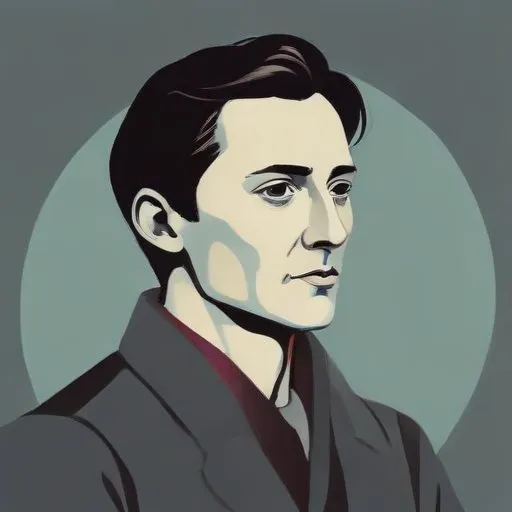
A Russian avant-garde poet and playwright who pioneered Futurist movement, experimenting with language and form, and is considered a precursor to Dadaism and Surrealism.
Velimir Khlebnikov, the enigmatic Russian poet and playwright, is renowned for his trailblazing contributions to the Russian Futurist movement, which revolutionized the literary landscape of the early 20th century. With his pioneering work, he earned the esteem of influential linguist Roman Jakobson, who hailed Khlebnikov as the greatest world poet of the century.
Born Viktor Vladimirovich Khlebnikov on November 9, 1885, in Malye Derbety, Astrakhan Governorate, Russian Empire (present-day Kalmykia), he was of Russian, Armenian, and Zaporozhian Cossack descent. His younger sister, Vera Khlebnikova, would later become an artist. Khlebnikov's early life was marked by his passion for literature, which led him to attend school in Kazan and later in Saint Petersburg. However, he eventually abandoned his academic pursuits to dedicate himself fully to writing.
Khlebnikov's earliest works date back to 1908, but it was his association with the Russian Futurists, including Vasily Kamensky, David Burliuk, and Vladimir Mayakovsky, in 1909-1910 that catapulted him to prominence. He became an integral part of Hylaea, the most significant Russian Futurist group, along with Mayakovsky, Aleksei Kruchenykh, David Burliuk, and Benedikt Livshits.
Khlebnikov's poetry was characterized by its innovative use of language, which blended the musicality of sound with the rhythmic flow of natural speech. His notable works include "Incantation by Laughter," "Bobeobi Sang The Lips," "The Grasshopper" (all 1908-1909), "Snake Train" (1910), and the prologue to the Futurist opera "Victory over the Sun" (1913). These poems showcased his unique ability to evoke the essence of the natural world and the human experience.
In addition to his poetic oeuvre, Khlebnikov's dramatic works, such as "Death's Mistake" (1915), and prose pieces, like "Ka" (1915), demonstrated his versatility as a writer. His experimentation with zaum, a term he coined to describe the use of transrational language, pushed the boundaries of literary expression. The "supertale" "Zangezi," a drama written partly in zaum, remains one of his most iconic works.
Khlebnikov's influence extends far beyond the Russian Futurist movement. His poetry and dramatic works have inspired generations of writers, artists, and thinkers. As a true maverick and a poet's poet, Khlebnikov's innovative spirit continues to captivate audiences, cementing his place as one of the most important literary figures of the 20th century.
Velimir Khlebnikov's life and work continue to inspire and intrigue, leaving an indelible mark on the world of literature and art.
Born in 1893
A Russian avant-garde artist who revolutionized poetry and theater with his bold, futuristic style and passionate performances. He's most famous for his vibrant, propaganda-inspired posters and poems that captured the spirit of the Russian Revolution.
Born in 1880
A Russian literary giant, known for pioneering the avant-garde movement in literature, blending poetry and prose to create innovative, symbolic works that explored the human experience.
Born in 1890
A Russian literary giant, renowned for his poetic and novelistic masterpieces, including the epic "Doctor Zhivago", which captured the essence of Soviet Russia. His works are a testament to the power of literature in shaping cultural identity.
Born in 1889
A renowned poet and literary icon of the Soviet era, celebrated for her poignant and evocative works that captured the essence of love, loss, and resilience amidst war and oppression.
Born in 1899
A Russian-born novelist and critic, renowned for crafting intricate, lyrical prose and exploring themes of identity, morality, and the human condition through works like "Lolita" and "Pale Fire".
Born in 1821
A Russian literary mastermind who penned psychologically complex novels that probed the human condition, exploring themes of morality, philosophy, and the darker aspects of human nature.
Born in 1828
A Russian literary giant who penned sweeping novels like "War and Peace" and "Anna Karenina", exploring the human condition with profound insight and masterful storytelling.
