


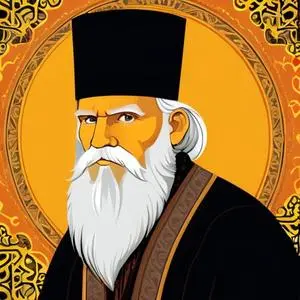
A Russian literary giant who penned sweeping novels like "War and Peace" and "Anna Karenina", exploring the human condition with profound insight and masterful storytelling.
Leo Tolstoy, a Russian literary icon, is renowned for his masterpieces, War and Peace and Anna Karenina, which are often cited as two of the greatest books of all time. His profound writing has had a lasting impact on literature, philosophy, and modern society, earning him a place among the most influential authors in history.
Born into an aristocratic family on September 9, 1828, Tolstoy's early life was marked by privilege and luxury. However, it was his experiences in the Crimean War that sparked his literary career, with his semiautobiographical trilogy, Childhood, Boyhood, and Youth, and Sevastopol Sketches, earning him critical acclaim in his twenties.
In the 1870s, Tolstoy underwent a profound moral crisis, followed by a spiritual awakening that transformed his life and writing. He became a fervent Christian anarchist and pacifist, advocating for nonviolent resistance and Georgism, the economic philosophy of Henry George.
Tolstoy's ideas on nonviolent resistance, spirituality, and social reform have had a lasting impact on modern society. His influence can be seen in the works of Mahatma Gandhi, Martin Luther King Jr., and Ludwig Wittgenstein, among others.
Tolstoy received numerous nominations for the Nobel Prize in Literature and the Nobel Peace Prize throughout his career, a testament to his enduring legacy.
"The only thing that is of practical importance is the ability to think clearly and to understand what one desires."
Leo Tolstoy's writing continues to inspire and influence people around the world, solidifying his place as one of the greatest authors of all time. His literary masterpieces, philosophical contributions, and social reform efforts have left an indelible mark on modern society, ensuring his legacy for generations to come.
Born in 1821
A Russian literary mastermind who penned psychologically complex novels that probed the human condition, exploring themes of morality, philosophy, and the darker aspects of human nature.
Born in 1899
A Russian-born novelist and critic, renowned for crafting intricate, lyrical prose and exploring themes of identity, morality, and the human condition through works like "Lolita" and "Pale Fire".
Born in 1860
A renowned Russian literary mastermind, celebrated for crafting poignant, psychologically nuanced tales that probe the human condition, and pioneering the modern short story genre.
Born in 1818
A Russian literary mastermind who crafted poignant novels and plays that explored the human condition, delving into themes of love, family, and social change.
Born in 1799
Russia's literary icon penned timeless tales of love, drama, and social commentary, leaving an indelible mark on the country's cultural heritage.
Born in 1814
A 19th-century Russian literary giant, known for his poignant poetry and novels that explored the human condition, particularly in the context of Russian society. His works are still widely read and studied today.
Born in 1880
A Russian literary giant, known for pioneering the avant-garde movement in literature, blending poetry and prose to create innovative, symbolic works that explored the human experience.
Born in 1893
A Russian avant-garde artist who revolutionized poetry and theater with his bold, futuristic style and passionate performances. He's most famous for his vibrant, propaganda-inspired posters and poems that captured the spirit of the Russian Revolution.
