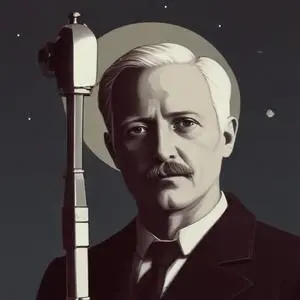
Percival Lowell: The Mars Enthusiast and Founder of the Lowell Observatory
The Canal Controversy and the Search for Planet X
Percival Lowell is best known for fueling speculation about the existence of canals on Mars and his tireless pursuit of a ninth planet within our solar system. His work in these areas led to the establishment of the Lowell Observatory in Flagstaff, Arizona, and ultimately contributed to the discovery of Pluto 14 years after his death.
Early Life and Education
Born on March 13, 1855, in Boston, Massachusetts, Percival Lowell was the first son of Augustus Lowell and Katherine Bigelow Lowell. A member of the Brahmin Lowell family, his siblings included the poet
Amy Lowell, the educator and legal scholar Abbott Lawrence Lowell, and Elizabeth Lowell Putnam, an early activist for prenatal care. Percival graduated from the Noble and Greenough School in 1872 and Harvard College in 1876 with distinction in mathematics.
Mathematical Pursuits and the Nebular Hypothesis
During his time at Harvard, Lowell joined the Delta Kappa Epsilon fraternity and gave a speech on the nebular hypothesis at his college graduation, considered advanced for its time. He was later awarded honorary degrees from Amherst College and Clark University.
A Life of Travel and Cultural Exploration
In the 1880s, Lowell traveled extensively in the Far East, serving as a foreign secretary and counselor for a special Korean diplomatic mission to the United States in August 1883. He lived in Korea for about two months and spent significant periods of time in Japan, writing books on Japanese religion, psychology, and behavior. His texts include
Noto: An Unexplored Corner of Japan (1891) and
Occult Japan, or the Way of the Gods.
Astronomical Ambitions and the Lowell Observatory
Lowell's fascination with Mars and the possibility of life on the planet led him to establish the Lowell Observatory in 1894. He designed and built the observatory himself, equipping it with a state-of-the-art telescope. The observatory became a hub for astronomical research, and Lowell spent countless nights studying the Martian surface.
The Search for Planet X and the Discovery of Pluto
Lowell's most enduring legacy is the search for a ninth planet in our solar system, which he believed was perturbing the orbits of Uranus and Neptune. Although he did not live to see it, his work laid the foundation for the discovery of Pluto in 1930 by
Clyde Tombaugh.
Philosophical Contributions and Beliefs
Lowell's work was not only driven by scientific curiosity but also by a deep fascination with the mysteries of the universe. He believed that the search for life beyond Earth was essential to understanding humanity's place in the universe.
Personal Milestones and Key Life Events
- 1855: Born in Boston, Massachusetts
- 1872: Graduated from the Noble and Greenough School
- 1876: Graduated from Harvard College with distinction in mathematics
- 1883: Served as a foreign secretary and counselor for a special Korean diplomatic mission to the United States
- 1891: Published Noto: An Unexplored Corner of Japan
- 1894: Established the Lowell Observatory
- 1916: Died on November 12th, at the age of 61
Legacy and Impact on Modern Society
Percival Lowell's work has had a lasting impact on the field of astronomy, inspiring generations of scientists to explore the mysteries of our solar system. His legacy continues to inspire new discoveries, and his name remains synonymous with the search for life beyond Earth.
FAQ
What was Percival Lowells contribution to astronomy?
Percival Lowell was an American astronomer and mathematician, who made significant contributions to the study of Mars and the discovery of Pluto. He also founded the Lowell Observatory in Flagstaff, Arizona.
What was Percival Lowells theory about Mars?
Lowell believed that Mars had a network of canals, which he thought were built by an intelligent civilization. Although this theory was later discredited, it sparked widespread interest in Mars and its potential for life.
What was Percival Lowells role in the discovery of Pluto?
Lowells work on the discovery of Pluto was instrumental, as he predicted the existence of a Planet X beyond Neptune. Although he did not live to see the discovery, his calculations ultimately led to the detection of Pluto in 1930.
What was Percival Lowells early life like?
Born on March 13, 1855, Percival Lowell grew up in a wealthy family in Boston, Massachusetts. He studied mathematics and astronomy at Harvard University, later pursuing a career in astronomy.
How is Percival Lowell remembered in astronomy?
Percival Lowell is remembered as a pioneering astronomer, who made significant contributions to our understanding of Mars and the discovery of Pluto. His legacy continues to inspire astronomers and space enthusiasts around the world.