


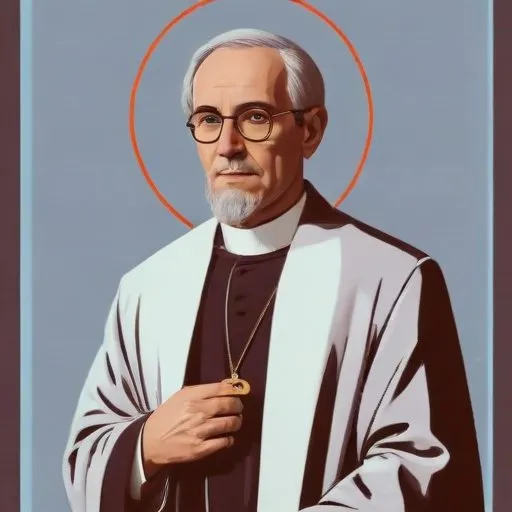
Co-founder of the Society of Jesus, a Catholic religious order known for its educational and missionary work, shaping modern Catholicism and education.
Peter Faber, a French Jesuit priest and theologian, is renowned for being one of the co-founders of the Society of Jesus, along with Ignatius of Loyola and Francis Xavier. This notable figure in Catholic history played a crucial role in shaping the Society, leaving an indelible mark on the Catholic Church.
Born on April 13, 1506, in Villaret, Duchy of Savoy (now Saint-Jean-de-Sixt in the French Department of Haute-Savoie), Faber came from a humble peasant family. As a young boy, he tended to sheep in the high pastures of the French Alps, where he developed an exceptional memory. This skill enabled him to repeat sermons verbatim, a talent that would later serve him well in his theological pursuits.
Faber's uncles, who were Carthusian priors, recognized his potential and entrusted him to the care of a priest in Thônes. Later, he attended a school in La Roche-sur-Foron, where he laid the foundation for his future academic endeavors. In 1525, Faber traveled to Paris to further his education, enrolling in the Collège Sainte-Barbe, the oldest school in the University of Paris.
It was in Paris that Faber's spiritual views began to take shape, influenced by popular devotion, Christian humanism, and late medieval scholasticism. During this period, he formed a close bond with Francis Xavier, with whom he shared lodgings and received the degree of Master of Arts in 1530.
Faber's association with Ignatius of Loyola, whom he met at the university, proved instrumental in shaping his theological perspectives. Loyola, in turn, tutored Faber in spiritual matters, while Faber instructed Loyola in the philosophy of Aristotle. This symbiotic relationship had a profound impact on Faber's understanding of his conscience and the temptations he faced.
In 1534, Faber, along with Xavier and Loyola, took a vow of poverty and chastity at Montmartre, marking the inception of the Society of Jesus. This pivotal moment in Catholic history would go on to shape the course of the Church and cement the Jesuits' reputation as a force for good.
Faber's remarkable preaching skills and his ability to connect with people from all walks of life made him an effective Jesuit preacher. He traveled extensively throughout Europe, spreading the message of Christ and promoting the Society's mission.
In 2013, Pope Francis announced Faber's canonization, recognizing his tireless efforts in spreading the Gospel and his role in shaping the Society of Jesus. Today, Peter Faber is revered as a saint, an inspiration to Catholics around the world.
Peter Faber's contributions to the Society of Jesus and the Catholic Church as a whole cannot be overstated. His commitment to spreading the Gospel, his role in shaping the Society, and his inspiring life and teachings continue to inspire Catholics and non-Catholics alike.
Faber's legacy extends beyond his theological pursuits, as he embodied the values of humility, compassion, and devotion that are at the heart of the Jesuit mission. His remarkable life serves as a testament to the power of faith and the human spirit, continuing to motivate generations to come.
Born in 1491
Founded the Jesuit Order, a Catholic religious organization known for its missionary and educational work, and developed the Spiritual Exercises, a guide for spiritual growth and discernment.
Born in 1506
Co-founder of the Society of Jesus, a Catholic religious order, known for his missionary work in Asia, especially in India and Japan, and for his role in the Counter-Reformation. He's revered for his tireless efforts to spread Christianity and his compassion for the poor and marginalized.
Born in 1521
A 16th-century Jesuit priest and doctor of the church, he played a crucial role in counter-reformation efforts, and his writings helped shape Catholic theology.
Born in 1542
A 16th-century theologian and doctor of the Church, known for his writings on spirituality and his role in shaping Catholic doctrine. He was a key figure in the Counter-Reformation, defending Catholicism against Protestantism.
Born in 1568
This 16th-century Jesuit saint is revered for his selfless devotion to caring for plague victims, ultimately sacrificing his life to save others. He's a powerful symbol of compassion and charity.
Born in 1550
A 16th-century Jesuit novice who died at 18, known for his strong devotion and miraculous healings, becoming a patron saint of youth and Poland.
Born in 1599
A 17th-century Belgian Jesuit scholastic and saint, known for his piety, kindness, and devotion to his studies, becoming a model for young Jesuits. He's revered for his heroic virtues and miracles attributed to his intercession.
