


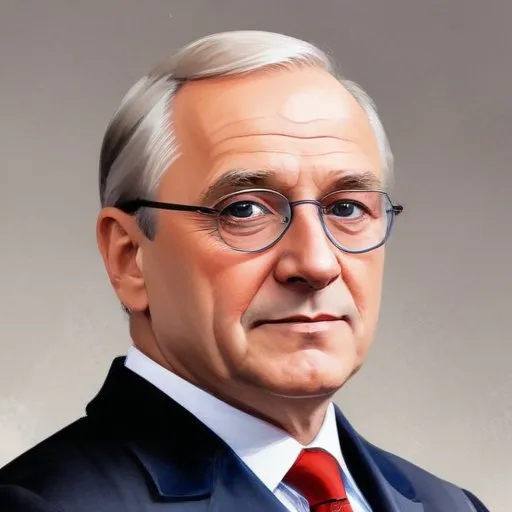
The German Federal Minister of Defence who served from 2002 to 2005 and played a key role in shaping the country's defence policy, particularly in the context of NATO and EU security. He's also known for his efforts to reform the German military.
As the German Minister of Defence under Chancellor Gerhard Schröder from 2002 to 2005, Peter Struck is renowned for his instrumental role in reforming the country's military and adapting it to the changing security landscape of the 21st century. Through his tenure, Struck oversaw the transformation of the German military into a more agile and responsive force, capable of addressing regional conflicts and global security threats.
Peter Struck was born on January 24, 1943, and embarked on a life of public service, dedicating himself to the Social Democratic Party (SPD). He studied law at the universities of Göttingen and Hamburg, graduating with a Doctor of Laws (Dr. iur.) in 1971.
Struck's political career spanned over three decades, during which he held various positions of responsibility. He was a member of the Bundestag from 1980 to 2009, serving as whip of the SPD parliamentary group from 1990 to 1998 and chairman of the SPD parliamentary group from 1998 to 2002.
As Federal Minister of Defence, Struck initiated a comprehensive reform of the German military, aimed at creating a more efficient and flexible force. He oversaw the reduction of the military's size by over 10% by 2010, leaving 250,000 troops. Struck also ordered a significant reduction in Germany's inventory of heavy Leopard 2 tanks, from almost 2,000 to 350.
Under Struck's leadership, the military's civilian workforce was reduced by 45,000, and as many as 100 military bases were closed. These reforms were driven by the need to adapt to new security challenges and address strained finances, with the defence budget at a mere 1.48% of Germany's gross domestic product.
During his tenure as Defence Minister, Struck oversaw Germany's early engagement in Afghanistan, which sparked controversy and debate. He faced criticism for his support of conscription, as well as his plans to reduce the military's size.
Peter Struck's reforms had a lasting impact on the German military, shaping its response to modern security threats. His leadership and vision helped to create a more agile and responsive force, capable of adapting to the changing global security landscape.
Struck's commitment to public service and his dedication to the Social Democratic Party have left an indelible mark on German politics. His legacy serves as a testament to the importance of effective leadership and visionary thinking in shaping the country's defence and security policies.
Today, Peter Struck's reforms continue to influence German defence policy, and his legacy serves as a reminder of the importance of adapting to changing security environments and embracing innovation in defence reform.
Peter Struck passed away on December 19, 2012, leaving behind a legacy of dedicated public service and visionary leadership in German defence policy.
82 Years Old
The 7th Chancellor of Germany, a lawyer-turned-politician, led the country from 1998 to 2005, implementing significant economic and social reforms. He's known for his efforts to modernize Germany and strengthen the European Union.
72 Years Old
The first female Chancellor of Germany, serving for 16 years, known for her leadership during the European sovereign-debt crisis and her role in shaping the European Union's policy. She's a highly influential figure in modern politics.
79 Years Old
German Minister of Finance from 2005 to 2009, known for his efforts to mitigate the effects of the global financial crisis and his role in shaping the European Union's economic policies.
70 Years Old
The 14th Vice-Chancellor of Germany, a seasoned politician and academic, served as the country's second-highest ranking official, playing a crucial role in shaping Germany's domestic and foreign policies. He's known for his diplomatic efforts and commitment to European integration.
72 Years Old
A German politician who served as Minister of the Interior and Minister of Defense, known for his efforts to reform the German military and intelligence services.
67 Years Old
A physician-turned-politician who served as Germany's Defense Minister and later became the President of the European Commission, known for shaping the EU's policies and response to global crises.
54 Years Old
A German politician who served as Federal Minister of Defence from 2009 to 2011, known for his charismatic leadership and later plagiarism scandal. He was a rising star in German politics until his downfall.
