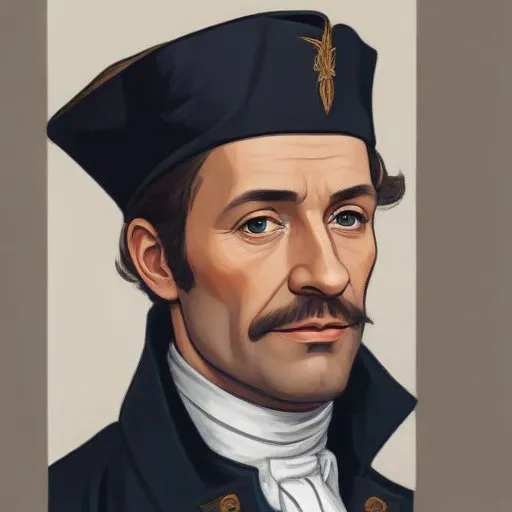
Philibert Commerson: The French Naturalist Who Charted Uncharted Territories
A Voyage of Discovery and Wonder
Philibert Commerson is best known for accompanying
Louis Antoine de Bougainville on his historic voyage of circumnavigation from 1766 to 1769, a journey that would take them across the globe, discovering new lands, and uncovering the secrets of the natural world. As a French naturalist, Commerson's contributions to the field of natural history are still felt today, with his observations and discoveries paving the way for future generations of scientists.
Early Life and Education
Born on November 18, 1727, in Châtillon-les-Dombes, France, Commerson studied in Montpellier, where he developed a passion for natural history. He went on to become a practicing physician, but his true calling was in the field of naturalism. It was during this time that he came into contact with the renowned Swedish botanist
Carl Linnaeus, who encouraged him to study the fish of the Mediterranean.
A Botanical Garden and a New Chapter
In 1758, Commerson returned to Châtillon-les-Dombes, where he established a botanical garden, a testament to his love for the natural world. However, his life took a dramatic turn with the death of his wife in 1764. This tragic event prompted him to move to Paris, where he began to focus on his work as a naturalist.
The Voyage of a Lifetime
In 1766, Commerson's big break came when he was recommended by the Paris Academy of Sciences to join Bougainville's voyage of circumnavigation. This journey would take them across the globe, visiting uncharted territories, and observing phenomena that few Europeans had ever seen before. Commerson's meticulous observations and notes would later become invaluable to the scientific community.
A Partner in Science and Life
Commerson's partner and assistant, Jeanne Baré, accompanied him on the voyage, disguised as a man. Baré's talents extended beyond her disguise, as she acted as a nurse to Commerson, who was often ill, as well as assisting him in his scientific work. Her presence on the voyage was a testament to Commerson's open-mindedness and trust in her abilities.
Observations of a Different Kind
Commerson's observations of the Tahitian people and culture were unlike those of his contemporaries. He approached the islanders with a remarkable lack of prejudice, earning him a unique insight into their way of life. His writings on the subject, though sometimes romanticized, painted the Tahitians as the embodiment of the concept of the noble savage.
A Legacy of Wonder
Commerson's legacy extends far beyond his voyage with Bougainville. He is remembered as a pioneer in the field of natural history, a man who charted uncharted territories, and brought the wonders of the natural world to the attention of the European public. His contributions to science, his passion for discovery, and his Trust in those around him have inspired generations of scientists, explorers, and enthusiasts alike.
A Final Note
Philibert Commerson's story is one of wonder, of discovery, and of the human spirit's capacity to explore and understand the world around us. His legacy continues to inspire us today, a testament to the power of curiosity and the importance of preserving our natural heritage.
FAQ
Who was Philibert Commerson?
Philibert Commerson was a French physician and explorer who lived in the 18th century. He is best known for his voyages to South America and his contributions to the field of botany.
What were Philibert Commersons contributions to botany?
Philibert Commerson discovered and described many new plant species during his voyages to South America. He also made significant contributions to the field of taxonomy and was one of the first scientists to study the flora of the Americas.
What was Philibert Commersons role in the French colonization of South America?
Philibert Commerson was a key figure in the French colonization of South America, particularly in present-day Uruguay and Argentina. He worked as a physician and naturalist on several expeditions to the region.
How did Philibert Commersons work influence later scientists?
Philibert Commersons work laid the foundation for later scientists such as Jean-Baptiste Lamarck and Charles Darwin. His discoveries and descriptions of new plant species helped to shape our understanding of the natural world.
What was Philibert Commersons relationship with Jeanne Baret?
Philibert Commerson had a close relationship with Jeanne Baret, a French botanist and explorer who accompanied him on several voyages. She was one of the first women to circumnavigate the globe and made significant contributions to the field of botany.