


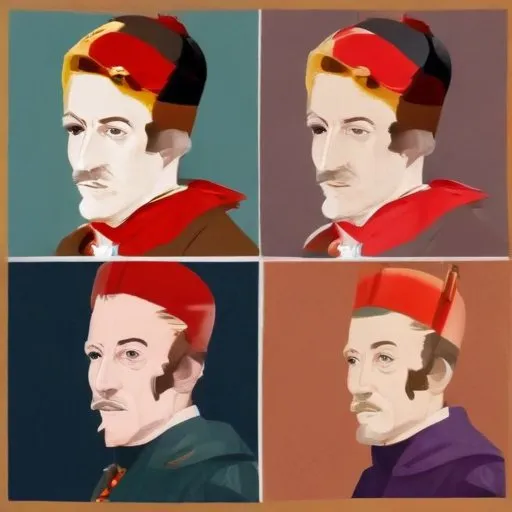
A 14th-century claimant to the Byzantine throne, known for his involvement in the Byzantine civil war of 1341-1347. He was a powerful nobleman in southern Italy, vying for control of the Eastern Roman Empire.
Philip I, Prince of Taranto, was a prominent figure of the Angevin house, holding multiple titles including titular Latin Emperor of Constantinople, Despot of Romania, King of Albania, and Prince of Achaea and Taranto. Born on November 10, 1278, in Naples, Philip's life was marked by a series of significant events that shaped his reign and legacy.
As the younger son of Charles II of Anjou, King of Naples, and Maria of Hungary, daughter of King Stephen V of Hungary, Philip was destined for greatness. On February 4, 1294, his father appointed him Prince of Taranto at Aix-en-Provence, and on July 12, 1294, Vicar-General of the Kingdom of Sicily. These dignities were a prelude to Charles' plan to bestow upon Philip an empire east of the Adriatic.
In 1294, Philip married Thamar Angelina Komnene, daughter of Nikephoros I Komnenos Doukas, Despot of Epirus, in a proxy ceremony. The marriage was a strategic alliance, with Nikephoros seeking Angevin patronage to counter the Byzantine Empire's threats. The couple married in person on August 13, 1294, at L'Aquila.
Upon their marriage, Charles ceded to Philip the suzerainty of Achaea and the Kingdom of Albania, as well as all his rights to the Latin Empire and the Lordship of Vlachia. Nikephoros gifted Philip the fortresses of Vonitsa, Vrachova, Gjirokastr, and Naupactus, in the territory of Aetolia, as Thamar's dowry. However, upon Nikephoros' death in 1297, Philip took the title of Despot of Romania, claiming Epirus, Aetolia, Acarnania, and Great Vlachia.
As Vicar-General of Sicily, Philip played a significant role in the invasion of the island during the latter stage of the War of the Sicilian Vespers. In 1299, his army was defeated at the Battle of Falconara by Frederick III of Sicily, and he was held prisoner until the signing of the Treaty of Caltabellotta.
Philip's life was marked by a series of power struggles, territorial expansions, and conflicts. Despite facing numerous challenges, he managed to maintain his titles and influence, leaving a significant legacy in the history of the Angevin house. His reign serves as a testament to the complex web of alliances and rivalries that shaped the medieval Mediterranean world.
Philip I, Prince of Taranto, led a life of intrigue, ambition, and conflict, leaving behind a legacy that continues to fascinate historians and scholars today.
Born in 1401
Queen of England from 1420 to 1422, married to King Henry V and mother of King Henry VI, playing a crucial role in the Hundred Years' War.
Born in 1505
Governor of the Habsburg Netherlands, known for her strong leadership and cultural patronage, fostering a golden age of arts and literature.
