


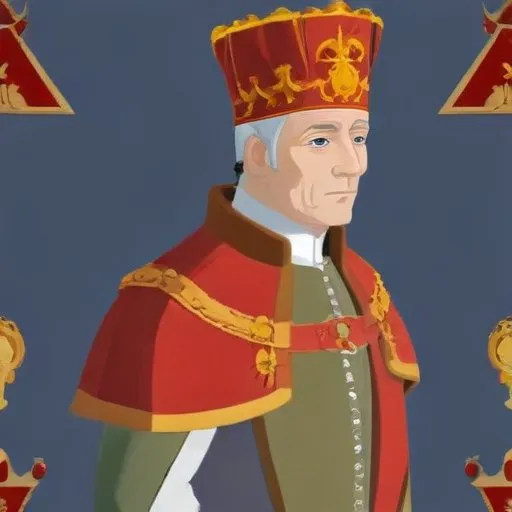
A German nobleman who ruled Hanau-Lichtenberg from 1480 to 1538, known for his territorial expansions and cultural developments. He was a patron of the arts and education, attracting scholars and artists to his court.
Philipp III, Count of Hanau-Lichtenberg, is best known for his bold decision to side with the Palatinate during the War of the Succession of Landshut (1503-1505), a move that would have far-reaching consequences for his family and territory. Despite being the eldest son of Count Philipp II of Hanau-Lichtenberg, Philipp III chose to defy his father's neutrality and support the Palatinate, earning him an imperial ban and a reputation as a reluctant rebel.
Born on October 18, 1482, in Bouxwiller (German: Buchsweiler), Philipp III was the eldest son of Count Philipp II of Hanau-Lichtenberg and his wife Anna of Isenburg-Büdingen. Little is known about his early life and education, but it is likely that he received a traditional noble upbringing, with a focus on military training, diplomacy, and governance.
The War of the Succession of Landshut was a brutal conflict between Bavaria and the Electorate of the Palatinate, sparked by the death of Duke George the Rich of Bavaria-Landshut in 1503. Philipp III's decision to side with the Palatinate was a bold move, given his father's neutrality in the conflict. The Palatinate ultimately lost the war, and Philipp III was slapped with an imperial ban by King Maximilian I, who resented his involvement in the conflict.
When Philipp III succeeded his father in 1504, he inherited a highly precarious situation. The imperial ban made it difficult for him to govern effectively, and he was forced to assign his half share in the condominium of Groß-Umstadt and Otzberg Castle to the Landgraviate of Hesse as compensation for their war costs. However, through a combination of diplomacy and luck, Philipp III was able to have the ban lifted in 1506, and was even appointed as an imperial councillor by King Maximilian I.
In 1521, Philipp III received partial compensation from Hesse and the Palatinate for his losses during the War of the Succession of Landshut, including the towns of Kleestadt and Langstadt, as well as a cash payment of 16,000 florins. While his losses were significant, Philipp III's eventual rehabilitation and compensation marked a significant turning point in his career.
Philipp III's legacy is complex and multifaceted. On the one hand, his decision to side with the Palatinate during the War of the Succession of Landshut showed remarkable courage and conviction, even if it ultimately proved costly. On the other hand, his ability to navigate the complex web of alliances and rivalries that characterized the early modern European landscape demonstrates a high degree of diplomatic skill and adaptability.
In the end, Philipp III's story serves as a reminder that even the most well-laid plans can go awry, and that true leadership involves navigating uncertainty and adversity with courage, wisdom, and resilience.
Through his complex and often tumultuous life, Philipp III, Count of Hanau-Lichtenberg, left an indelible mark on the history of Europe, reminding us that even the most unlikely of heroes can emerge in the most unexpected of times.
Born in 1533
Led the Dutch Revolt against Spanish rule, establishing the Netherlands as an independent nation and paving the way for its Golden Age of prosperity and cultural flourishing.
Born in 1683
King of Great Britain and Ireland from 1727 to 1760, known for his military victories, particularly the Battle of Dettingen, and his role in the War of the Austrian Succession.
