


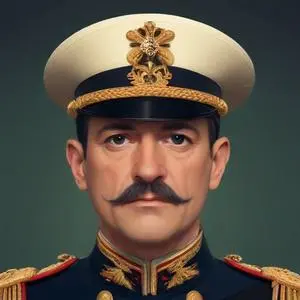
Led the Free French Forces during WWII, playing a crucial role in the liberation of Paris and ultimately contributing to the Allied victory.
Philippe Leclerc de Hauteclocque, known to the French nation as "le maréchal Leclerc" or simply "Leclerc," was a Free French general during World War II who became a legendary figure for his bravery, strategic thinking, and unwavering commitment to the liberation of France. He is most famous for being one of the first to defy the French government's armistice with Germany, fleeing to Britain to continue fighting with the Free French under General Charles de Gaulle.
Born on November 22, 1902, into an aristocratic family, Leclerc de Hauteclocque graduated from the École Spéciale Militaire de Saint-Cyr, the French military academy, in 1924. After serving with the French Occupation of the Ruhr and in Morocco, he returned to Saint-Cyr as an instructor. During his early years, he was awarded the Croix de Guerre des Théâtres d'Opérations Exterieures for leading goumiers in an attack on caves and ravines in Bou Amdoun on August 11, 1933.
When France surrendered to Germany in 1940, Leclerc de Hauteclocque refused to accept defeat. Fearing for his family's safety, he adopted the nom de guerre "Leclerc" and made his way to Britain to join the Free French forces under General Charles de Gaulle. In French Equatorial Africa, he rallied local leaders to the rebel Free French cause and led a force against Gabon, whose leaders supported the French Government. From Chad, he launched raids into Italian Libya, demonstrating his daring and strategic thinking.
One of Leclerc's most famous achievements was the creation of the "Oath of Kufra," a pledge taken by his men to fight on until the French flag flew over the Strasbourg Cathedral. This oath, taken in 1941, became a beacon of hope for the French people and a symbol of their determination to resist German occupation.
Throughout the war, Leclerc's forces, known as L Force and later as the 2e Division Blinde, played a crucial role in several key battles, including the Battle of Normandy, the liberation of Paris, and the capture of Strasbourg. Leclerc's unwavering commitment to the cause of French liberation earned him the respect and admiration of his troops and the French people.
After the war, Leclerc de Hauteclocque was hailed as a national hero and promoted to Marshal of France posthumously in 1952. His legacy continues to inspire generations of French citizens, and his name is synonymous with bravery, honor, and patriotism.
Leclerc de Hauteclocque's words continue to evoke the spirit of resistance and liberation:
Leclerc de Hauteclocque's life was marked by significant milestones, including:
Philippe Leclerc de Hauteclocque's remarkable life and legacy serve as a testament to the power of courage, determination, and loyalty. His story continues to inspire and motivate people around the world, reminding us that even in the darkest of times, hope and freedom can prevail.
Born in 1890
A French military leader who led the Free French Forces during WWII and later became President of France, known for his strong leadership and vision for a unified Europe.
Born in 1890
Led the Allied forces to victory in World War II and later served as President, maintaining peace and prosperity during the Cold War era. He's known for his strategic leadership and diplomatic skills.
Born in 1889
A French general who led the First Army to victory in World War II, liberating Marseille and playing a key role in the Allied invasion of Germany. He's also known for his post-war efforts to modernize the French military.
Born in 1879
A French general who led the Free French Forces during World War II and later became a politician, known for his role in the Allied invasion of North Africa. He played a key role in shaping France's post-war government.
Born in 1888
A highly decorated military leader who played a crucial role in World War II, particularly in the Italian Campaign, and later became a prominent figure in French politics.
