


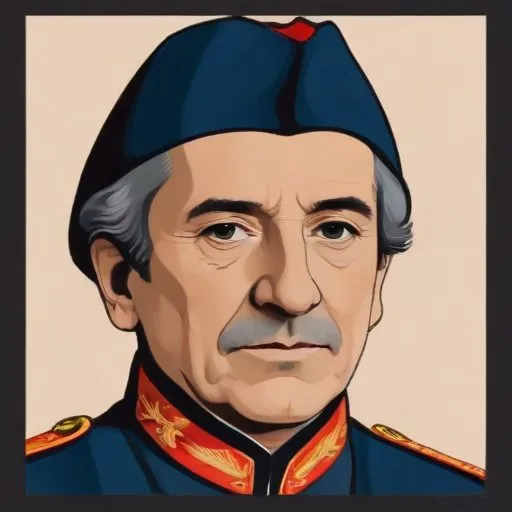
A French general who led the Free French Forces during World War II and later became a politician, known for his role in the Allied invasion of North Africa. He played a key role in shaping France's post-war government.
Henri Giraud, a French military officer, is renowned for leading the Free French Forces during World War II and his daring escape from German captivity not once, but twice. His bravery and strategic prowess earned him recognition as a key figure in the war effort, alongside notable leaders like Charles de Gaulle, Winston Churchill, and Franklin D. Roosevelt.
Born on January 18, 1879, in Paris to an Alsatian family, Giraud graduated from the prestigious Saint-Cyr Military Academy in 1900. He joined the French Army as a sub-lieutenant in the 4th Zouaves and quickly distinguished himself, qualifying for admission to the École supérieure de guerre in 1907.
Giraud's military career saw him fight in World War I, where he was wounded and captured by the Germans. However, he managed to escape from his prisoner-of-war camp, showcasing his cunning and resourcefulness. During the interwar period, he fought in the Rif War, earning the Légion d'honneur for his bravery.
In 1940, Giraud was again captured by the Germans while fighting in the Netherlands. This time, he spent two years planning his escape, which he finally accomplished in April 1942. From within Vichy France, he secretly collaborated with the Allies, eventually assuming command of French troops in North Africa after Operation Torch in November 1942.
In January 1943, Giraud participated in the historic Casablanca Conference alongside de Gaulle, Churchill, and Roosevelt. Later that year, he and de Gaulle became co-presidents of the French Committee of National Liberation, although Giraud eventually lost support and retired in April 1944.
After the war, Giraud was elected to the Constituent Assembly of the French Fourth Republic. He passed away on March 11, 1949, in Dijon, leaving behind a legacy as a fearless military leader and a champion of French freedom.
Henri Giraud's bravery and strategic prowess during World War II continue to inspire military leaders and historians alike. His legacy serves as a reminder of the importance of courage, perseverance, and leadership in the face of adversity.
Born in 1890
A French military leader who led the Free French Forces during WWII and later became President of France, known for his strong leadership and vision for a unified Europe.
Born in 1856
A French general who led the country to defeat in World War II and later collaborated with the Nazis, serving as the Chief of State of Vichy France. He's infamous for his role in the French surrender and subsequent authoritarian regime.
Born in 1888
A key architect of the European Union, credited with uniting a war-torn continent through economic cooperation and integration. His vision for a unified Europe has shaped modern politics and global relations.
Born in 1901
A French businessman and politician who served as Prime Minister of France, known for his role in shaping the country's post-war economy and European integration. He was a key figure in the creation of the European Coal and Steel Community, a precursor to the European Union.
Born in 1907
A French lawyer and politician who served as Prime Minister of France, known for his progressive reforms and efforts to modernize the country's economy and government. He's a significant figure in French post-war history.
Born in 1888
A highly decorated military leader who played a crucial role in World War II, particularly in the Italian Campaign, and later became a prominent figure in French politics.
Born in 1889
A French general who led the First Army to victory in World War II, liberating Marseille and playing a key role in the Allied invasion of Germany. He's also known for his post-war efforts to modernize the French military.
