


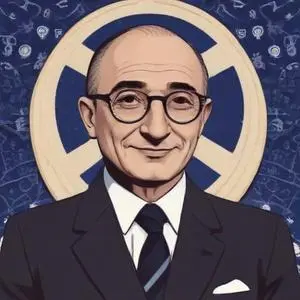
A key architect of the European Union, credited with uniting a war-torn continent through economic cooperation and integration. His vision for a unified Europe has shaped modern politics and global relations.
Jean Monnet, a French civil servant, entrepreneur, diplomat, financier, and administrator, is widely regarded as one of the founding fathers of the European Union. He is credited with establishing the European Coal and Steel Community, the precursor to today's European Union, earning him the title "The Father of Europe."
Born on November 9, 1888, in Cognac, France, Monnet came from a family of cognac merchants. His father, Jacques-Gabriel Monnet, had taken control of a mid-sized distiller and distributor of cognac, which was later renamed J.G. Monnet & Cie. in 1901. Monnet's mother, Marie Demelle, was deeply religious, and his sister Marie-Louise was a founder of the French branch of Action Catholique.
Monnet's career was marked by his innovative and pragmatic approach to international relations. During World War I, he worked for the French Supply Commission in London, where he developed his skills as a diplomat and entrepreneur. In the 1920s and 1930s, he worked as an international financier, advising governments and companies on economic issues.
In the aftermath of World War II, Monnet became a key figure in the movement for European unity. He believed that a united Europe was the only way to prevent future wars and promote economic prosperity. In 1950, he presented the Schuman Plan, which proposed the creation of a European Coal and Steel Community (ECSC). The plan was adopted by six European countries, marking the beginning of European integration.
The ECSC was the first supranational organization in Europe, and it paved the way for the creation of the European Economic Community (EEC) and eventually the European Union. Monnet was appointed as the first president of the ECSC's High Authority in 1952, a position he held until 1955.
Monnet's relationship with Charles de Gaulle, the French president, was complex and multifaceted. While they shared a commitment to European unity, they had differing views on the role of France in the process. De Gaulle saw France as a leader in European integration, while Monnet believed in a more supranational approach.
In recognition of his contributions to European unity, Monnet was awarded numerous honors, including the title of Honorary Citizen of Europe in 1976. In 1988, his remains were transferred to the Panthéon in Paris, a rare honor reserved for France's greatest citizens.
Monnet's legacy extends far beyond his role in the creation of the European Union. He remains an inspiration to those working towards greater international cooperation and peace. His commitment to European unity and his innovative approach to international relations continue to shape the course of European history.
Through his tireless efforts and vision, Jean Monnet has left an indelible mark on European history, earning him the title "The Father of Europe."
Born in 1810
A renowned Romantic-era composer and influential music critic, known for his expressive and emotionally charged works, including symphonies, piano music, and art songs.
Born in 1876
Led post-war West Germany's reconstruction and served as a key figure in shaping the country's modern identity, earning him the title "Father of the Federal Republic."
Born in 1890
Led the Allied forces to victory in World War II and later served as President, maintaining peace and prosperity during the Cold War era. He's known for his strategic leadership and diplomatic skills.
Born in 1890
A French military leader who led the Free French Forces during WWII and later became President of France, known for his strong leadership and vision for a unified Europe.
Born in 1871
Prolific writer of historical novels and adventure stories, also a talented landscape painter.
Born in 1882
Led the United States through the Great Depression and World War II, implementing a series of reforms known as the New Deal and helping to establish the country as a global superpower.
Born in 1884
The 33rd President of the United States, a strong leader who made tough decisions, including dropping atomic bombs on Japan and establishing the Marshall Plan to rebuild Europe after WWII.
Born in 1880
A highly decorated military leader and statesman who played a crucial role in shaping post-WWII foreign policy and was awarded the Nobel Peace Prize for his efforts. He's most known for authoring the Marshall Plan, a massive economic aid program that helped rebuild war-torn Europe.
