


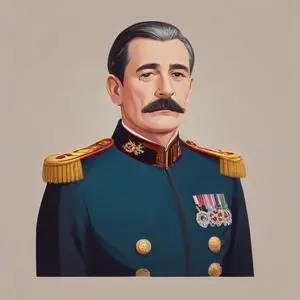
A French general who led the country to defeat in World War II and later collaborated with the Nazis, serving as the Chief of State of Vichy France. He's infamous for his role in the French surrender and subsequent authoritarian regime.
Philippe Pétain, also known as Marshal Pétain, is renowned for his exceptional military leadership during World War I, particularly at the Battle of Verdun, where he earned the nickname "The Lion of Verdun." However, his later role as the head of the collaborationist regime of Vichy France during World War II has sparked controversy and tarnished his legacy.
Born on April 24, 1856, in Cauchy-à-la-Tour, France, Pétain joined the Saint-Cyr Military Academy in 1876, marking the beginning of his illustrious military career. He rose through the ranks, becoming a colonel by the outbreak of World War I.
Pétain's leadership during the nine-month-long Battle of Verdun in 1916 earned him widespread recognition and acclaim. He successfully defended the city, and his tactical prowess and ability to boost morale made him a national hero.
After the failed Nivelle Offensive and subsequent mutinies, Pétain was appointed Commander-in-Chief, and he successfully restored control and stabilized the French Army. He remained in command for the rest of the war, further solidifying his reputation as a brilliant military strategist.
Between the wars, Pétain served as the head of the peacetime French Army, commanded joint Franco-Spanish operations during the Rif War, and held ministerial positions twice. He was affectionately known as "le vieux Maréchal" (The Old Marshal) during this period.
In 1940, as the German army advanced on France, Prime Minister Paul Reynaud resigned, and President Albert Lebrun appointed Pétain as his replacement. Pétain's government subsequently voted to transform the French Third Republic into the French State, also known as Vichy France, an authoritarian regime that collaborated with the Axis powers.
Under Pétain's leadership, Vichy France worked closely with the Nazi German military administration, leading to widespread criticism and controversy. His regime was marked by anti-Semitic laws, human rights abuses, and collaboration with the enemy, earning him the scorn of the French Resistance and the Allies.
Pétain's complex and contradictory legacy has sparked intense debate among historians and scholars. While his military achievements during World War I are undeniable, his role in Vichy France has tarnished his reputation and left a lasting stain on French history.
Despite his controversial later years, Pétain's early military achievements and his role in shaping French history during World War I remain significant and influential. His legacy serves as a reminder of the complexities and challenges of leadership during times of war and crisis.
"We will not surrender. We will not capitulate." - Philippe Pétain, during the Battle of Verdun
"France has lost a battle, but France has not lost the war." - Philippe Pétain, after the Fall of France in 1940
Born in 1890
A French military leader who led the Free French Forces during WWII and later became President of France, known for his strong leadership and vision for a unified Europe.
Born in 1871
Prolific writer of historical novels and adventure stories, also a talented landscape painter.
Born in 1889
The dictator of Nazi Germany, responsible for the genocide of six million Jews and millions of other people during World War II, and infamous for his extreme nationalist and anti-Semitic ideology.
Born in 1878
The Soviet Union's ruthless leader who ruled with an iron fist, implementing policies that led to widespread famine and purges, while also playing a crucial role in defeating Nazi Germany in World War II.
Born in 1883
Italian fascist revolutionary and politician who led the National Fascist Party and ruled Italy from 1922 to 1943, known for his authoritarian regime and aggressive military campaigns.
Born in 1892
The authoritarian leader who ruled Spain with an iron fist from 1939 to 1975, suppressing opposition and imposing conservative values, while also modernizing the economy. He's infamous for his brutal regime and human rights abuses.
Born in 1893
A high-ranking Nazi official, he was a decorated World War I fighter pilot and later became a prominent politician, serving as Minister President of Prussia. He's infamous for his role in the Nazi regime and war crimes trials.
Born in 1883
A French politician who served as Prime Minister of France during World War II, known for collaborating with the Nazi regime and implementing anti-Semitic policies. He is infamous for his role in the French Resistance and the Holocaust.
