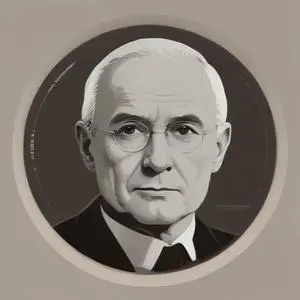
Pierre Cartier: A Mathematician of Unparalleled Contributions
Pierre Cartier, a French mathematician born on June 10, 1932, is renowned for his groundbreaking work in algebraic geometry, representation theory, mathematical physics, and category theory. He is particularly notable for introducing the Cartier operator in algebraic geometry in characteristic p, as well as his work on duality of abelian varieties and formal groups.
Early Life and Education
Cartier studied at the prestigious École Normale Supérieure in Paris, where he was mentored by the esteemed mathematicians
Henri Cartan and
André Weil. His 1958 thesis on algebraic geometry laid the foundation for his future contributions to the field.
Contributions and Achievements
Cartier's work has had a profound impact on various areas of mathematics. Some of his notable contributions include:
- The introduction of the Cartier operator in algebraic geometry in characteristic p, a concept that has far-reaching implications in number theory and algebraic geometry.
- His work on duality of abelian varieties, which has had significant influence on the study of algebraic geometry and number theory.
- His contributions to the theory of formal groups, which has applications in algebraic geometry, number theory, and theoretical physics.
Awards and Honors
Cartier's exceptional work has been recognized with several awards and honors, including:
- The 1978 Prize Ampère of the French Academy of Sciences.
- Fellowship of the American Mathematical Society in 2012.
Publications and Collaborations
Cartier has co-authored several books and papers with prominent mathematicians, including:
- Problèmes combinatoires de commutation et réarrangements with Dominique Foata in 1969.
- From Number Theory to Physics with Michel Waldschmidt, Pierre Moussa, and Claude Itzykson in 1992.
- A Primer of Hopf Algebras in 2006.
- Freedom in Mathematics with Cédric Villani, Jean Dhombres, and Gerhard Heinzmann in 2016.
Influence on Modern Mathematics
Cartier's work has had a profound impact on modern mathematics, influencing the development of algebraic geometry, number theory, and mathematical physics. His contributions have paved the way for future generations of mathematicians, ensuring his legacy as a pioneer in his field.
Legacy and Impact
Pierre Cartier's work has left an indelible mark on the world of mathematics. His contributions continue to inspire and influence mathematicians today, solidifying his position as one of the most important mathematicians of the 20th century.
FAQ
What was Pierre Cartiers contribution to mathematics?
Pierre Cartier is a French mathematician who has made significant contributions to algebraic geometry, number theory, and algebraic topology. He is known for his work on the theory of algebraic curves and their applications.
What awards did Pierre Cartier receive for his work?
Pierre Cartier has received several awards for his work, including the Crafoord Prize from the Royal Swedish Academy of Sciences and the Émile Picard Medal from the French Academy of Sciences.
What is Pierre Cartiers work on algebraic curves about?
Pierre Cartiers work on algebraic curves focuses on their geometric and arithmetic properties. He has made important contributions to the study of modular forms, elliptic curves, and their applications to number theory.
What is Pierre Cartiers role in the development of modern algebraic geometry?
Pierre Cartier has played a key role in the development of modern algebraic geometry, particularly in the area of algebraic curves and their applications. His work has influenced many mathematicians and has had a lasting impact on the field.
What is Pierre Cartiers legacy in mathematics?
Pierre Cartiers legacy in mathematics is that of a true innovator and pioneer. He is remembered for his fundamental contributions to algebraic geometry, number theory, and algebraic topology, and his work continues to inspire mathematicians around the world.