


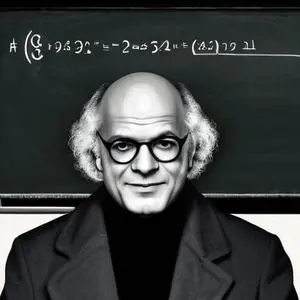
A pioneer in algebraic geometry, revolutionizing the field with innovative ideas and abstract approaches, shaping modern mathematics and influencing generations of mathematicians.
Alexander Grothendieck is renowned for being the leading figure in the creation of modern algebraic geometry, a field that has been transformed by his groundbreaking research. His work has had a profound impact on pure mathematics, extending the scope of algebraic geometry and incorporating elements of commutative algebra, homological algebra, sheaf theory, and category theory.
Grothendieck was born on March 28, 1928, in Berlin, Germany, to anarchist parents with diverse backgrounds. His father, Alexander Sascha Schapiro, had Hasidic Jewish roots, while his mother, Johanna Hanka Grothendieck, came from a Protestant German family. This eclectic upbringing influenced Grothendieck's future pursuits.
He began his productive career as a mathematician in 1949 and quickly gained recognition for his innovative approach. In 1958, he was appointed a research professor at the Institut des Hautes Études Scientifiques (IHÉS), where he remained until 1970.
In 1966, Grothendieck received the prestigious Fields Medal for his outstanding contributions to algebraic geometry, homological algebra, and K-theory. This award solidified his position as a leading mathematician of his time.
Grothendieck's mathematical pursuits were deeply intertwined with his philosophical and religious beliefs. He was drawn to Buddhism and later adopted a more Catholic Christian vision, which influenced his approach to mathematics. His work reflects a deep understanding of the interconnectedness of mathematical concepts and their application to the human experience.
In 1970, Grothendieck left IHÉS due to a dispute over military funding, marking a significant turning point in his life. He subsequently became a professor at the University of Montpellier, where he continued to produce influential mathematical work.
In 1991, he moved to the French village of Lasserre in the Pyrenees, where he lived in seclusion, devoting himself to mathematics, philosophy, and religious pursuits until his death in 2014.
Grothendieck's work has had a profound impact on modern mathematics, shaping the development of algebraic geometry and inspiring generations of mathematicians. His contributions have far-reaching implications for fields such as physics, computer science, and engineering.
Grothendieck's strong convictions and unconventional approach often led to controversies and disputes with his colleagues. His withdrawal from the mathematical community and adoption of a reclusive lifestyle added to the enigma surrounding his persona.
Alexander Grothendieck's legacy extends far beyond his mathematical contributions. He has inspired a new generation of mathematicians, philosophers, and thinkers to explore the intricate relationships between mathematics, philosophy, and human experience.
His work continues to influence modern mathematics, and his vision has paved the way for future breakthroughs in algebraic geometry and beyond. Grothendieck's remarkable journey serves as a testament to the power of human ingenuity and the boundless potential of the human mind.
Born in 1906
A French mathematician and academic who made significant contributions to number theory, algebraic geometry, and the development of modern mathematics, leaving a lasting impact on the field.
Born in 1926
A renowned mathematician and academic, he is most known for his groundbreaking work in algebraic geometry and number theory, earning him a Fields Medal in 1954.
82 Years Old
A renowned mathematician and academic who made groundbreaking contributions to algebraic geometry, number theory, and representation theory, earning him a Fields Medal in 1978.
Born in 1917
A renowned mathematician who made significant contributions to number theory, particularly in the development of the Selberg trace formula, and was awarded the Fields Medal and the Abel Prize.
77 Years Old
A renowned mathematician and academic who made groundbreaking contributions to differential geometry, topology, and geometric analysis, earning him a Fields Medal and numerous other accolades.
