


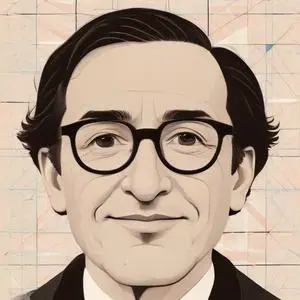
A renowned mathematician and academic who made groundbreaking contributions to algebraic geometry, number theory, and representation theory, earning him a Fields Medal in 1978.
Pierre Deligne, a Belgian mathematician, is renowned for his groundbreaking work on the Weil conjectures, which led to a complete proof in 1973. His remarkable contributions to mathematics have earned him numerous prestigious awards, including the 2013 Abel Prize, 2008 Wolf Prize, 1988 Crafoord Prize, and 1978 Fields Medal.
Deligne was born on October 3, 1944, in Etterbeek, Belgium. He attended school at Athénée Adolphe Max and later studied at the Université libre de Bruxelles (ULB), where he wrote a dissertation titled "Théorème de Lefschetz et critères de dégénérescence de suites spectrales" (Theorem of Lefschetz and Criteria of Degeneration of Spectral Sequences). He completed his doctorate at the University of Paris-Sud in Orsay in 1972 under the supervision of Alexander Grothendieck, with a thesis titled "Théorie de Hodge" (Hodge Theory).
Deligne's career is marked by his collaborations with influential mathematicians, including Alexander Grothendieck and Jean-Pierre Serre. His work with Serre led to important results on the l-adic representations attached to modular forms and the conjectural functional equations of L-functions. Deligne's focus on Hodge theory led him to introduce the concept of weights and test them on objects in complex geometry.
Deligne's contributions have had a profound impact on modern mathematics, particularly in the fields of algebraic geometry, number theory, and arithmetic geometry. His work has inspired a new generation of mathematicians, and his legacy continues to influence research in these areas.
Through his tireless efforts, Deligne has expanded our understanding of the fundamental principles of mathematics, leaving an indelible mark on the discipline. As a testament to his remarkable contributions, he remains one of the most celebrated mathematicians of our time.
98 Years Old
A pioneer in algebraic geometry, revolutionizing the field with innovative ideas and abstract approaches, shaping modern mathematics and influencing generations of mathematicians.
Born in 1926
A renowned mathematician and academic, he is most known for his groundbreaking work in algebraic geometry and number theory, earning him a Fields Medal in 1954.
97 Years Old
A renowned mathematician and academic who made groundbreaking contributions to topology, geometry, and theoretical physics, earning him numerous accolades, including the Fields Medal and Abel Prize.
73 Years Old
Proved Fermat's Last Theorem, a problem that went unsolved for over 350 years, and made significant contributions to number theory. His work has far-reaching implications for mathematics and cryptography.
51 Years Old
A renowned mathematician who has made significant contributions to harmonic analysis, partial differential equations, and number theory, earning him numerous awards, including the Fields Medal.
54 Years Old
A Vietnamese-French mathematician and academic who made significant contributions to the field of mathematics, particularly in the areas of algebraic geometry and number theory. He was a prolific researcher and educator who inspired a new generation of mathematicians.
