


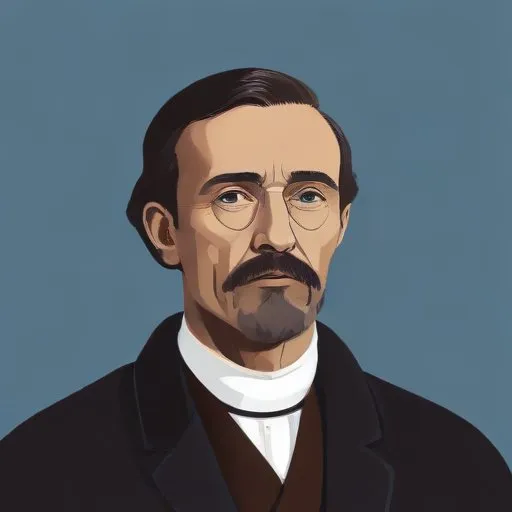
French astronomer and mathematician who discovered helium and observed a solar eclipse, making significant contributions to our understanding of the sun and its composition.
Pierre Janssen, a renowned French astronomer, etched his name in the annals of history alongside English scientist Joseph Norman Lockyer, with their groundbreaking discovery of the gaseous nature of the solar chromosphere. This pioneering feat made him an icon in the field of astronomy, marking the beginning of a new era of scientific exploration.
Born on February 22, 1824, in Paris, France, during the Bourbon Restoration, Janssen was born into a cultivated family with a rich cultural heritage. His father, Csar Antoine Janssen, was a well-known clarinettist of Dutch-Belgian descent, while his mother, Pauline Marie Le Moyne, was a daughter of the prominent architect Paul Guillaume Le Moyne.
Janssen pursued his passion for mathematics and physics at the Faculty of Sciences, laying the foundation for his future scientific endeavors.
Janssen's dedication to scientific missions took him to various corners of the globe. In 1857, he embarked on a journey to Peru to determine the magnetic equator. He later ventured to Italy and Switzerland in 1861-1862 and 1864 to study telluric absorption in the solar spectrum.
Janssen's fascination with solar eclipses led him to participate in numerous expeditions. He successfully observed the transits of Venus in Japan (1874) and Algeria (1882), as well as solar eclipses in Trani, Italy (1867), Guntur, India (1868), Algiers (1870), Siam (1875), the Caroline Islands (1883), and Alcossebre, Spain (1905).
In 1870, during the Siege of Paris, Janssen escaped in a balloon to observe the solar eclipse, although clouds obscured his view.
In 1874, Janssen invented the Revolver of Janssen, also known as the Photographic Revolver. This innovative instrument enabled the development of chronophotography, which later became an essential tool for researchers like Etienne-Jules Marey.
Pierre Janssen's remarkable contributions to astronomy and physics have left an indelible mark on the scientific community. His discoveries and inventions continue to inspire future generations of scientists and researchers.
Through his tireless efforts, Janssen expanded our understanding of the solar chromosphere, paving the way for further exploration and research in the field of astronomy.
Janssen's outstanding achievements earned him numerous accolades and recognition. He was honored with various awards and distinctions, solidifying his position as a pioneer in the scientific community.
Pierre Janssen's remarkable life and achievements have left a lasting legacy in the world of science, inspiring future generations to continue exploring and pushing the boundaries of human knowledge.
Born in 1787
Developed the first spectroscope, discovering 574 dark lines in the sun's spectrum, now known as Fraunhofer lines, which helped establish the field of spectroscopy.
Born in 1818
Italian astronomer and academic who pioneered spectroscopy, discovering that stars have unique spectral signatures, and was the first to classify stars based on their spectra.
Born in 1811
Predicted the existence and location of Neptune, a previously unknown planet, through mathematical calculations, revolutionizing astronomy.
Born in 1749
Developed nebular hypothesis of the origin of the solar system and formulated Laplace's equation, a fundamental concept in mathematics and physics. He's considered the founder of celestial mechanics.
Born in 1774
A French polymath who made significant contributions to the fields of physics, astronomy, and mathematics, particularly in the discovery of chromatic polarization and the Biot-Savart law.
Born in 1786
A mathematician and politician who made significant contributions to the development of electromagnetism and served as Prime Minister of France, advocating for social reform and education.
Born in 1819
Developed the method of measuring the speed of light using a rotating wheel with teeth, and was the first to accurately measure the speed of light in 1849.
