


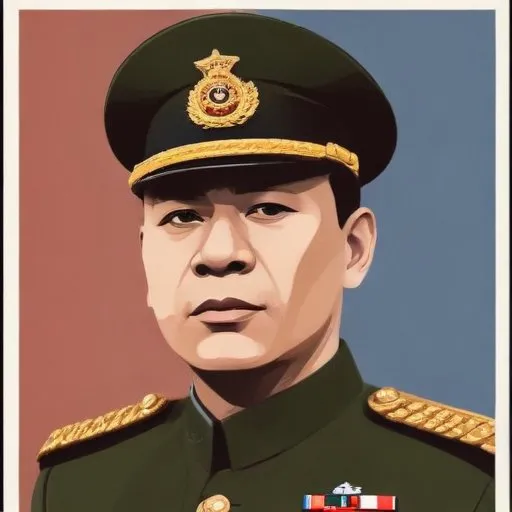
A Thai military leader who served as Prime Minister from 1938 to 1944 and again from 1948 to 1957, known for his nationalist and modernizing policies. He's also infamous for his authoritarian rule and anti-Chinese sentiment.
Plaek Phibunsongkhram, alternatively transcribed as Pibulsongkram or Pibulsonggram, is renowned as the Prime Minister of Thailand who catapulted the country into modernity, twice holding office from 1938 to 1944 and 1948 to 1957. He is celebrated for his pivotal role in transforming Thailand's absolute monarchy into a constitutional monarchy, and for his far-reaching modernization efforts that continue to shape the nation's identity.
Born on July 14, 1897, Plaek Phibunsongkhram was a member of the Army wing of Khana Ratsadon, Thailand's first political party. He played a key role in the Siamese revolution of 1932, which marked the end of absolute monarchy and the beginning of a new era in Thai politics. Phibun's military prowess and political acumen led to his appointment as Commander of the Royal Siamese Army and, subsequently, as the third Prime Minister of Thailand in 1938.
Inspired by the ideals of Benito Mussolini, Phibun established a de facto military dictatorship, promoting Thai nationalism and Sinophobia. He launched the Thai Cultural Revolution, a series of cultural mandates that transformed the country's identity, including changing the country's name from Siam to Thailand and promoting the Thai language.
Ousted as Prime Minister in 1944, Phibun returned to power after the Siamese coup d'état of 1947. During his second term, he aligned Thailand with anticommunism in the Cold War and entered the Korean War under the United Nations Command. Phibun's regime, though still authoritarian, adopted a facade of democracy, attempting to transform Thailand into an electoral democracy from the mid-1950s onward.
Phibun's second term was marked by political instability, with several attempts to launch a coup d'état against him. Despite these challenges, he maintained a stronghold on power until his eventual overthrow in 1957. His legacy is complex, with critics accusing him of authoritarianism and nationalists praising his efforts to modernize Thailand.
Phibun's reforms continue to shape Thailand's national identity, with his promotion of the Thai language and culture remaining a cornerstone of Thai society. His legacy serves as a testament to the complex interplay between authoritarianism and modernization, highlighting the challenges of balancing national identity with democratic values.
"The nation is one, the people are one, and the language is one."
Through his life's work, Plaek Phibunsongkhram forged a modern Thailand, grappling with the complexities of power, identity, and democracy. His tumultuous tenure continues to influence the nation, serving as a reminder of the delicate balance between stability and freedom.
Born in 1911
A Thai military leader who served as Prime Minister of Thailand from 1963 to 1973, known for his authoritarian rule and role in the 1973 Thai student uprising.
