


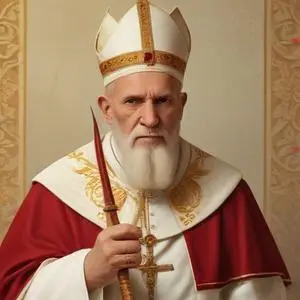
Commissioned iconic artworks like Michelangelo's Sistine Chapel ceiling and launched the Catholic Church's Counter-Reformation, shaping Western art and Catholicism.
Pope Julius II is remembered as one of the most powerful and influential popes in Catholic history, earning the nicknames "Warrior Pope," "Battle Pope," and "Fearsome Pope." This stalwart leader played a pivotal role in shaping the High Renaissance, leaving an indelible mark on art, architecture, politics, and culture.
Born Giuliano della Rovere on December 5, 1443, Pope Julius II was destined for greatness. A member of the powerful della Rovere family, he was groomed from a young age to take on prominent roles within the Catholic Church. He quickly rose through the ranks, becoming a bishop, cardinal, and eventually, the head of the Catholic Church and ruler of the Papal States in 1503.
During his reign, Pope Julius II embarked on a series of ambitious projects that would transform the face of Rome and cement his legacy as a patron of the arts. In 1506, he established the Vatican Museums, amassing a vast collection of ancient artifacts, sculptures, and artworks. He also initiated the rebuilding of St. Peter's Basilica, commissioning some of the most renowned artists of the time, including Donato Bramante, Michelangelo, and Raphael.
Pope Julius II's vision extended beyond the realm of art and architecture. He centralized the Papal States, increasing their power and influence throughout Italy and Europe. His diplomatic prowess and strategic alliances helped establish the Catholic Church as a dominant force in global politics. The office of the papacy continued to play a crucial role in European politics throughout the 16th century, thanks in large part to Pope Julius II's efforts.
Pope Julius II's love for art and architecture led to some of the most iconic works of the Renaissance. In 1508, he commissioned Raphael to paint the famous Raphael Rooms in the Vatican Palace, and Michelangelo to create the breathtaking frescoes on the ceiling of the Sistine Chapel. These masterpieces continue to inspire awe and admiration to this day.
Pope Julius II's political acumen earned him recognition from none other than Niccolò Machiavelli, who described him as an ideal prince in his works. The pope's ability to navigate complex alliances and rivalries helped him expand the Papal States, while his shrewd diplomacy secured the Treaty of Tordesillas, establishing the first bishoprics in the Americas and launching the Catholicization of Latin America.
Not everyone was enamored with Pope Julius II's leadership style. Described by some as ruthless and power-hungry, he faced criticism for his decision to allow people seeking indulgences to donate money to the Church, which would be used for the construction of St. Peter's Basilica. The satirist Erasmus of Rotterdam even penned a scathing critique, "Julius Excluded from Heaven," in which the pope is denied entry to heaven and forced to justify his worldly pursuits.
Pope Julius II's influence extends far beyond his own lifetime. His patronage of the arts helped shape the Renaissance, while his political maneuvers established the Catholic Church as a dominant force in global politics. Today, his legacy serves as a testament to the power of visionary leadership and the enduring impact of art and culture on society.
"I will not live in the same palace as a friend of the French."
At the heart of Pope Julius II's remarkable story lies a testament to the transformative power of art, politics, and culture. As a trailblazer of the Renaissance, he continues to inspire generations, leaving an indelible mark on the course of human history.
Born in 1475
Renaissance master of iconic works like the ceiling of the Sistine Chapel, creating breathtakingly beautiful and emotionally powerful art that continues to inspire and awe.
Born in 1452
Renaissance mastermind behind iconic works like the Mona Lisa and The Last Supper, who revolutionized art, science, and engineering with his inventive and curious nature.
Born in 1469
Italian historian and philosopher who wrote "The Prince", a seminal work on politics and power that still influences modern leadership and governance today.
Born in 1449
Renaissance leader who ruled Florence and sponsored artists like Michelangelo and Botticelli, shaping the city's cultural and artistic heritage.
Born in 1535
The second shortest-reigning pope in history, serving for just 27 days in 1605, he is most known for his brief but tumultuous papacy marked by power struggles and controversy.
Born in 1431
Ruthless and cunning, this Pope was infamous for his corrupt and immoral ways, using his power to further his family's interests.
Born in 1475
A ruthless and cunning politician who rose to power in the Renaissance era through intrigue and military conquest, leaving a lasting legacy in politics and governance.
