


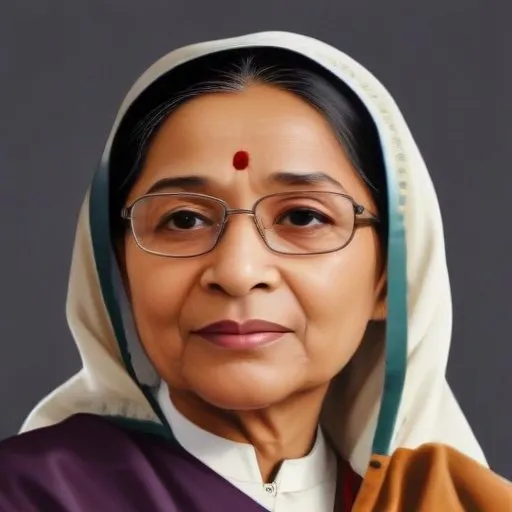
The first female President of India, serving from 2007 to 2012, known for her efforts to empower women and the underprivileged. She played a significant role in shaping India's foreign policy and promoting education.
Pratibha Patil is renowned for her historic election as the first woman to hold the office of President of India, serving from 2007 to 2012. This monumental achievement marked a significant milestone in Indian history, solidifying her position as a pioneering figure in Indian politics.
Born on December 19, 1934, in Nadgaon, Maharashtra, Pratibha Patil hails from a Marathi family. Her father, Narayan Rao Patil, instilled in her the importance of education, which would become a cornerstone of her future success. She pursued her education at R. R. Vidyalaya and later earned a master's degree in Political Science and Economics from Mooljee Jetha College, Jalgaon, and a Bachelor of Law degree from Government Law College, Bombay.
Patil's foray into politics began in 1962, when she was elected to the Maharashtra Legislative Assembly at the age of 27. This marked the beginning of a remarkable career that would span over four decades. She went on to win four consecutive terms in the Muktainagar constituency between 1967 and 1985, followed by a stint as a Member of Parliament in the Rajya Sabha from 1985 to 1990. Her dedication to public service led to her election as a Member of Parliament in the 10th Lok Sabha in 1991, representing the Amravati constituency.
Patil's perseverance and commitment to social causes earned her various Cabinet portfolios in the Maharashtra Legislative Assembly. She also held official positions in the Rajya Sabha and Lok Sabha, and served as the president of the Maharashtra Pradesh Congress Committee. In 2004, she was appointed as the Governor of Rajasthan, a post she held until 2007, when she assumed the presidency of India.
As the first female President of India, Patil worked tirelessly to promote education, women's empowerment, and social welfare. Her presidency witnessed significant initiatives, including the establishment of the National Mission for Female Literacy and the launching of the Rajiv Gandhi Scheme for Empowerment of Adolescent Girls.
Patil's leadership was guided by her strong belief in the power of education and the importance of empowering women. She advocated for inclusive growth, emphasizing the need for sustainable development and social justice.
Pratibha Patil married Devisingh Ramsingh Shekhawat in 1965, and they have two children, Jyoti Rathore and Raosaheb Shekhawat, who is also a politician. Her personal journey is a testament to her unwavering commitment to public service and her dedication to creating a better India.
Pratibha Patil's remarkable journey serves as an inspiration to women across India and beyond. Her determination, perseverance, and commitment to public service have left an indelible mark on Indian history, making her a role model for generations to come.
93 Years Old
The 13th Prime Minister of India, a renowned economist who led the country through a period of rapid economic growth and liberalization, implementing reforms that transformed India's economy. He is credited with helping to lift millions of people out of poverty.
79 Years Old
The first female President of the Indian National Congress, leading the party to a landslide victory in 2004, and playing a crucial role in shaping India's political landscape.
56 Years Old
Indian National Congress leader and scion of the Nehru-Gandhi family, known for his efforts to revitalize the party and promote social justice.
Born in 1924
A renowned Indian poet and politician who served as the country's 10th Prime Minister, known for his efforts to strengthen India's economy and improve relations with neighboring countries.
75 Years Old
The Chief Minister of Gujarat and 14th Prime Minister of India, a prominent figure in Indian politics, known for his economic reforms and nationalist agenda. He has been a dominant force in Indian politics for over two decades.
85 Years Old
Indian Minister of Agriculture who played a crucial role in shaping the country's agricultural policies and is credited with introducing several reforms to benefit farmers.
