


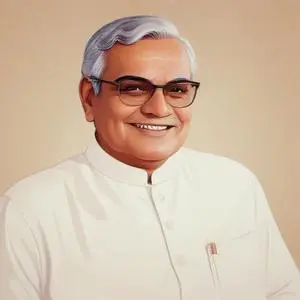
A renowned Indian poet and politician who served as the country's 10th Prime Minister, known for his efforts to strengthen India's economy and improve relations with neighboring countries.
Atal Bihari Vajpayee, the stalwart of Indian politics, is renowned for his phenomenal leadership as the 10th Prime Minister of India, marking a significant milestone in the country's history. Serving three non-consecutive terms, Vajpayee's tenure witnessed remarkable reforms, strengthened international relations, and a resolute stance on national security.
Born on December 25, 1924, in Gwalior, Madhya Pradesh, Vajpayee was destined for greatness. His early life was deeply rooted in the Rashtriya Swayamsevak Sangh (RSS), a Hindu nationalist organization, which instilled in him the values of selfless service and nation-building. He went on to become a prominent figure in Indian politics, leaving an indelible mark on the country's trajectory.
Vajpayee's prime ministerial tenure was marked by numerous achievements, demonstrating his commitment to India's growth and development.
Vajpayee's life and work were guided by the principles of Hindu nationalism, democratic values, and a strong sense of nationhood. His vision for India was built on the pillars of economic growth, social harmony, and international cooperation.
Atal Bihari Vajpayee's legacy continues to inspire generations, embodying the spirit of selfless service and nation-building. His contributions to Indian politics, diplomacy, and poetry have left an indelible mark on the country's history, ensuring his place as one of India's most revered leaders.
Vajpayee's profound impact on modern society is a testament to his unwavering commitment to India's growth and development. As a poet, politician, and statesman, he will be remembered for generations to come as a beacon of hope, vision, and leadership.
Born in 1889
India's first Prime Minister, a key figure in the country's struggle for independence from British rule, and a champion of democracy and secularism. He played a crucial role in shaping modern India's government and economy.
Born in 1917
The first female Prime Minister of India, serving from 1966 to 1977 and again from 1980 until her assassination in 1984, known for her strong leadership and economic reforms.
81 Years Old
The 6th Prime Minister of India, a key figure in Indian politics, known for introducing economic reforms and promoting technology in the country. He was also a strong advocate for social justice and equality.
Born in 1896
Fourth Prime Minister of India, known for his efforts to decentralize power and promote economic development, and for being the first Indian Prime Minister to resign from office.
Born in 1902
The 5th Prime Minister of India, a champion of rural development and social justice, who implemented land reforms and empowered farmers. He played a crucial role in shaping India's agricultural sector and economy.
Born in 1919
A poet and politician who served as India's 12th Prime Minister, known for his diplomatic efforts to improve relations with neighboring countries, particularly Pakistan. He's also recognized for his literary works, including poetry and essays.
93 Years Old
An Indian farmer-turned-politician who served as the 11th Prime Minister of India, known for his humble beginnings and unexpected rise to power. He played a key role in shaping India's economy and foreign policy during his tenure.
93 Years Old
The 13th Prime Minister of India, a renowned economist who led the country through a period of rapid economic growth and liberalization, implementing reforms that transformed India's economy. He is credited with helping to lift millions of people out of poverty.
