


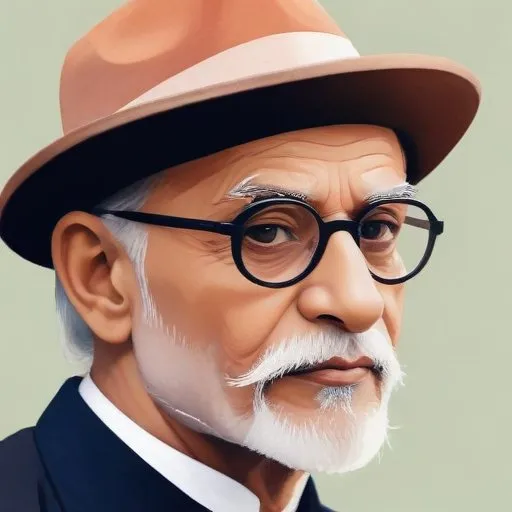
A poet and politician who served as India's 12th Prime Minister, known for his diplomatic efforts to improve relations with neighboring countries, particularly Pakistan. He's also recognized for his literary works, including poetry and essays.
Inder Kumar Gujral, commonly known as I. K. Gujral, was an Indian politician who served as the 12th Prime Minister of India from April 1997 to March 1998. He is best known for his Gujral Doctrine, a set of principles aimed at improving India's relations with its neighbors.
I. K. Gujral was born on December 4, 1919, in Jhelum, Punjab Province, British India (now in Pakistan). He came from a family of moderately wealthy merchants. Gujral completed his education in Urdu, Persian, and English at D.A.V. College, Hailey College of Commerce, and Forman Christian College in Lahore.
Gujral's political career spanned over five decades, during which he held various prominent positions. He started his political career with the Indian National Congress and was a member of the Indian Parliament's Rajya Sabha from 1964 to 1976. He later joined the Janata Party and became the Minister of Information and Broadcasting in the Morarji Desai government.
In 1997, Gujral became the Prime Minister of India, heading a United Front government. During his tenure, he introduced several reforms, including the establishment of the National Human Rights Commission and the introduction of the 80th Constitutional Amendment to provide for greater autonomy to the states.
The Gujral Doctrine is a set of five principles propounded by I. K. Gujral to guide India's relations with its neighbors. The doctrine emphasizes the need for goodwill, friendship, and cooperation among neighboring countries. It is based on the principles of:
Gujral was awarded the Padma Vibhushan, India's second-highest civilian honor, in 1999. He also received the Bangladesh Liberation War Honor, a rare honor bestowed upon him by the Government of Bangladesh in 2012.
I. K. Gujral was married to Sheila Gujral, a well-known poet and writer. He had two sons, Naresh and Vishal. Gujral passed away on November 30, 2012, at the age of 92. His legacy continues to inspire Indian politics and international relations.
Gujral's approach to foreign policy and his emphasis on regional cooperation have had a lasting impact on India's relations with its neighbors. His vision for a more integrated and cooperative South Asia remains an important aspect of India's foreign policy to this day.
93 Years Old
The 13th Prime Minister of India, a renowned economist who led the country through a period of rapid economic growth and liberalization, implementing reforms that transformed India's economy. He is credited with helping to lift millions of people out of poverty.
Born in 1924
A renowned Indian poet and politician who served as the country's 10th Prime Minister, known for his efforts to strengthen India's economy and improve relations with neighboring countries.
79 Years Old
The first female President of the Indian National Congress, leading the party to a landslide victory in 2004, and playing a crucial role in shaping India's political landscape.
81 Years Old
The 6th Prime Minister of India, a key figure in Indian politics, known for introducing economic reforms and promoting technology in the country. He was also a strong advocate for social justice and equality.
Born in 1917
The first female Prime Minister of India, serving from 1966 to 1977 and again from 1980 until her assassination in 1984, known for her strong leadership and economic reforms.
Born in 1889
India's first Prime Minister, a key figure in the country's struggle for independence from British rule, and a champion of democracy and secularism. He played a crucial role in shaping modern India's government and economy.
Born in 1904
The second Prime Minister of India, leading the country through a tumultuous period, including a war with Pakistan, and known for his simplicity, honesty, and dedication to the nation. He is also credited with promoting the Green Revolution, which transformed India's agricultural sector.
Born in 1896
Fourth Prime Minister of India, known for his efforts to decentralize power and promote economic development, and for being the first Indian Prime Minister to resign from office.
