


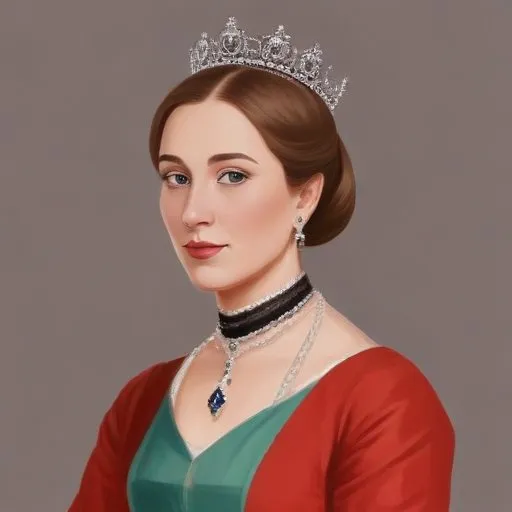
Granddaughter of Queen Victoria, she was a member of the British royal family and a patron of several charitable organizations, known for her humanitarian work.
Princess Alexandra of SaxeCoburg and Gotha, also known as Alexandra Louise Olga Victoria, was a princess of the United Kingdom and a member of the Russian imperial family. Born on September 1, 1878, she was the fourth child and third daughter of Alfred, Duke of SaxeCoburg and Gotha, and Grand Duchess Maria Alexandrovna of Russia, making her a granddaughter of both Queen Victoria of the United Kingdom and Tsar Alexander II of Russia.
Baptized on October 2, 1878, at Edinburgh Palace, Coburg, Alexandra's early life was marked by her father's absence, occupied with his naval career, and later as a ruler in Coburg. Her mother, Grand Duchess Maria Alexandrovna, was the dominant figure in her children's lives. Alexandra had four siblings: Alfred, Marie, Victoria Melita, and Beatrice, with whom she shared a close bond.
Known affectionately as "Sandra" by her family, Alexandra spent her childhood in England, Malta (1886-1889), and later in Coburg, Germany (1889). She was a bridesmaid at the 1885 wedding of her aunt, Princess Beatrice of the United Kingdom, to Prince Henry of Battenberg, and at the wedding of the Duke of Connaught and Strathearn to Princess Louise Margaret of Prussia.
In 1896, Alexandra married Prince Ernst II of Hohenlohe-Langenburg, becoming the Princess consort of Hohenlohe-Langenburg. The couple had five children together, with Alexandra taking an active role in raising them. Her husband was known for his scholarly pursuits, and Alexandra was said to have supported his interests, despite being overshadowed by her more outgoing sisters, Marie and Victoria Melita.
During World War I, Alexandra dedicated herself to war relief efforts, particularly in supporting the Red Cross. Her son, Gottfried, fought on the German side, while her daughter, Marie Melita, married a Russian officer. Alexandra's marriage to Ernst II was marked by periods of separation due to the war, during which she focused on her charitable work.
Princess Alexandra's life was characterized by her dedication to her family and philanthropic pursuits, despite being overshadowed by her more prominent sisters. As a member of the Russian imperial family and the British royal family, Alexandra's life was intertwined with the complexities of European royalty. Her legacy is a testament to the often-unsung contributions of lesser-known royal family members.
Alexandra's marriage to Prince Ernst II was criticized by some, who viewed her husband as a German prince, rather than a British or Russian royal. Additionally, her son's involvement in the German army during World War I sparked controversy. However, Alexandra's commitment to her family and charitable work helped to mitigate these criticisms.
Princess Alexandra of SaxeCoburg and Gotha's life serves as a reminder that even in the shadows of royal grandeur, individuals can make significant contributions to their families and communities.
Born in 1819
The monarch who ruled the British Empire for 63 years, overseeing the Industrial Revolution and expanding the empire's reach, earning the nickname "the Grandmother of Europe".
Born in 1900
The wife of King George VI and mother of Queen Elizabeth II, known for her strong support of the British people during World War II and her iconic sense of style.
Born in 1921
The husband of Queen Elizabeth II, supporting her reign and carrying out numerous philanthropic and ceremonial duties, while also advocating for environmental conservation and education.
