


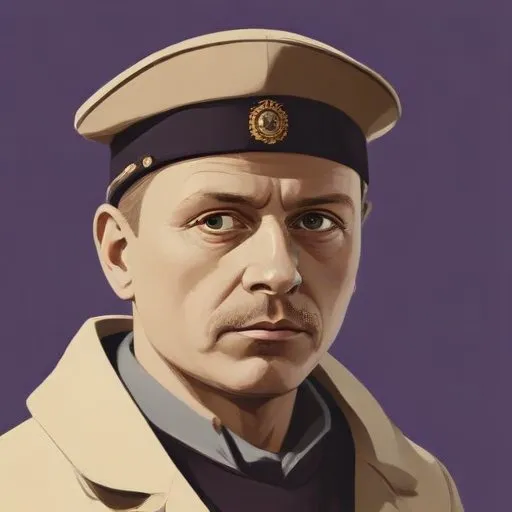
Russian archaeologist and explorer who led several expeditions to Mongolia and Tibet, discovering ancient cities and artifacts, including the famous Orkhon Valley inscriptions. He also mapped the Gobi Desert and discovered the ruins of Khara-Khoto.
Pyotr Kozlov, a Russian and Soviet traveler and explorer, is renowned for continuing the studies of Nikolai Przhevalsky in Mongolia and Tibet. His expeditions unveiled the secrets of the upper reaches of the Yellow River, Yangtze, and Mekong rivers, earning him the prestigious Constantine Medal in 1902.
Born on October 3, 1863, in Dukhovshchina, Russia, Kozlov's parents had envisioned a military career for him. However, he defied their expectations by joining Nikolai Przhevalsky's expedition, a decision that would shape the course of his life.
After Przhevalsky's untimely death, Kozlov continued traveling in Asia with Przhevalsky's successors, Pevtsov and Roborovsky. In 1895, he took command of the expedition from the ailing Roborovsky, demonstrating his exceptional leadership skills.
During the first decade of the 20th century, Kozlov rivaled Sven Hedin and Aurel Stein as the foremost researcher of Xinjiang. His 1905 visit to the Dalai Lama in Urga sparked concern among the British War Office, as the Lama expressed his intention to settle within the confines of Russia.
Kozlov's most iconic expedition, spanning from 1907 to 1909, led him to explore the Gobi Desert, where he discovered the ruins of Khara-Khoto, a Tangut city destroyed by the Ming Chinese in 1372. This remarkable find yielded over 2,000 books in the Tangut language, which he painstakingly excavated and transported to St. Petersburg.
Kozlov's groundbreaking discoveries earned him the 1911 Royal Geographical Society's Founders Medal for his explorations. His remarkable work, "Mongolia and Amdo and the Dead City of Khara-Khoto," published in 1923, is a testament to his dedication to the field.
Kozlov's final expedition to Mongolia and Tibet, from 1923 to 1926, resulted in the discovery of an unprecedented number of Xiongnu royal burials at Noin-Ula. This remarkable find further solidified his reputation as a pioneering explorer.
Pyotr Kozlov's unwavering commitment to exploration and discovery has left an indelible mark on the world of geography and anthropology. His untiring spirit of adventure continues to inspire generations of explorers, historians, and enthusiasts alike.
Born in 1865
A Swedish geographer and explorer who mapped previously unknown areas of Central Asia, including the Silk Road, and discovered the Transhimalaya mountain range.
Born in 1839
A Russian geographer and explorer who mapped much of Central Asia, discovering new species and charting unexplored territories. He's considered the "Russian Marco Polo" for his extensive travels and contributions to the field of geography.
Born in 1904
First Deputy Premier of the Soviet Union during the Khrushchev era, overseeing key economic sectors and implementing reforms. He played a crucial role in shaping the Soviet economy and industrial development.
