


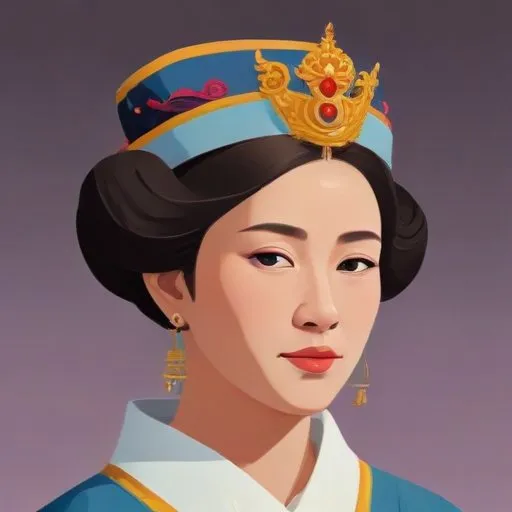
A 16th-century Korean queen who ruled as regent for her son and implemented significant reforms, strengthening the monarchy and promoting education and the arts.
Queen Munjeong, the third wife and queen consort of King Jungjong, is remembered as one of the most influential and powerful women in the Joseon dynasty. She was a masterful politician, administrator, and patron of Buddhism, who played a crucial role in shaping the kingdom's policies and future.
Born on December 12, 1501, Queen Munjeong was a member of the prestigious Papyeong Yun clan. Her father, Yun JiIm, was a respected official, and her mother, a member of the Jeonui Lee clan, was a descendant of the Goryeo dynasty's royal family.
Queen Munjeong's rise to power began when she married King Jungjong in 1517, becoming the queen consort of Joseon. After her husband's death in 1544, she was honored as Queen Dowager Seongryeol and later as Grand Queen Dowager Seongryeol during the reigns of her stepson and son, respectively.
However, it was during her regency for her son, King Myeongjong, from 1545 to 1553, that Queen Munjeong truly demonstrated her political prowess. She stepped down from her formal position as regent but retained significant influence, eventually becoming the de facto ruler of the Joseon empire for nearly two decades.
Queen Munjeong's administrative skills were unparalleled. She implemented a series of reforms that benefited the common people, including the redistribution of land from the nobility to the masses. This move not only empowered the people but also bolstered her popularity and reputation as a just ruler.
The queen was a devout Buddhist and a generous patron of the religion. Her support for Buddhism led to the construction of numerous temples and the promotion of Buddhist scholars and artists. Her philanthropy and patronage had a profound impact on the development of Korean Buddhism during the Joseon era.
Queen Munjeong's rise to power was not without controversy. Her brother, Yun Wonhyeong, wielded significant influence during her regency, leading to accusations of nepotism and abuse of power. The Fourth Literati Purge of 1545, orchestrated by her brother, further solidified her grip on power but also led to criticism and opposition from rival factions.
Queen Munjeong's impact on Korean history is undeniable. She played a crucial role in shaping the Joseon dynasty's policies, promoted Buddhism, and empowered the common people. Her legacy as one of the most powerful and influential queens in Korean history remains unmatched.
Queen Munjeong's remarkable life serves as a testament to her intelligence, determination, and vision. She remains an inspiration to generations, a true leader who left an indelible mark on Korean history.
Born in 1397
Creator of the Korean alphabet, Hangul, and a visionary leader who promoted education, science, and the arts, transforming Korea into a cultural and economic powerhouse.
Born in 1367
The third king of the Joseon Dynasty, he's known for establishing a strong and efficient government, reforming the tax system, and creating a professional military. He's also infamous for his ruthless purge of officials who opposed him.
