


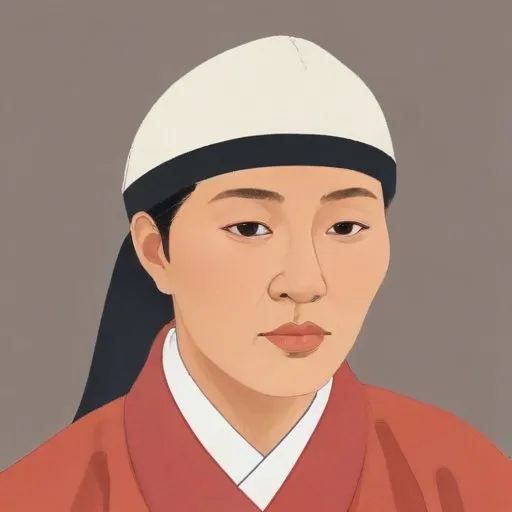
The third king of the Joseon Dynasty, he's known for establishing a strong and efficient government, reforming the tax system, and creating a professional military. He's also infamous for his ruthless purge of officials who opposed him.
Taejong, the third monarch of the Joseon dynasty, is infamous for his cunning, brutality, and centralized power, earning him the title of one of Korea's most significant leaders. He is known for his purge of potential rivals, consolidation of power, and implementation of policies that shaped the course of Korean history.
Yi Bangwon, Taejong's birth name, was born in 1367 as the fifth son of King Taejo, the founder of the Joseon dynasty. He studied under Confucian scholars and played a crucial role in assisting his father in gathering support from commoners and influential figures in the government.
Before ascending to the throne, Taejong was known as Prince Jeongan. He helped his father overthrow the Goryeo dynasty by assassinating powerful officials who remained loyal to the previous regime. His role in the founding of Joseon and his subsequent contributions earned him recognition as a key figure in Korea's transition to a new dynasty.
A power struggle ensued when Taejong's father and Chief State Councillor Jeong Dojeon favored Taejo's eighth son, Yi Bangseok, as the successor to the throne. Taejong disagreed, advocating for direct rule through an absolute monarchy. This conflict ultimately led to the First Strife of Princes, a coup d'état in 1398 that resulted in the deaths of Jeong Dojeon, his supporters, and the late Queen Sindeok's two sons, including the crown prince.
Taejong's ascension to the throne in 1400 marked the beginning of a new era of centralized power and reforms. He purged potential rivals, abolished the office of the Chief State Councillor, and implemented policies that strengthened the monarchy.
Key reforms included the creation of the Hungmuwon, a military unit that answered directly to the king, and the establishment of the Saheonbu, a censorate that monitored government officials. Taejong also promoted Confucianism as the official state ideology, solidifying its influence on Korean society.
Taejong's reign, marked by bloodshed and brutality, ultimately laid the foundation for the Joseon dynasty's prosperity. His implementation of policies and reforms created a strong, centralized government that enabled the dynasty to thrive for nearly five centuries.
Despite his ruthless methods, Taejong is remembered as a visionary leader who shaped Korea's destiny. His legacy continues to influence Korean politics, culture, and society to this day.
Taejong was the father of Sejong the Great, one of Korea's most beloved monarchs. He married Queen Wonkyeong, and their union produced five sons and three daughters.
Taejong's reign coincided with the early years of the Joseon dynasty, a period marked by turmoil and power struggles. His actions, though brutal, ensured the dynasty's survival and paved the way for future generations of Korean leaders.
Taejong's legacy is complex, with both critics and admirers recognizing his impact on Korean history. Love him or hate him, Taejong remains an enigmatic figure, remembered for his cunning, strength, and vision.
Born in 1335
Founder of the Joseon dynasty, he unified various warring states and established a new capital, laying the foundation for a prosperous and culturally rich era in Korean history.
Born in 1397
Creator of the Korean alphabet, Hangul, and a visionary leader who promoted education, science, and the arts, transforming Korea into a cultural and economic powerhouse.
