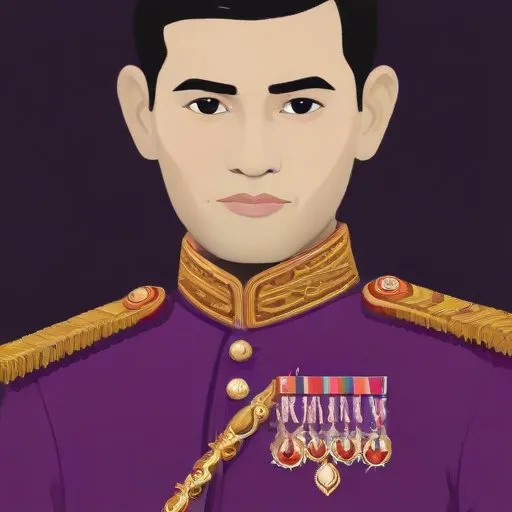
Rama I: The Founder of the Rattanakosin Kingdom
Early Life and Rise to Power
Rama I, also known as Phutthayotfa Chulalok, is renowned as the founder of the Rattanakosin Kingdom and the first monarch of the reigning Chakri dynasty of Siam, now known as Thailand. He ascended the throne in 1782, following the deposition of King Taksin of Thonburi, and is celebrated as the founder of Rattanakosin, now Bangkok, as the new capital of the reunited kingdom.
Rama I was born in 1737 to a Mon male line descent family, with his father serving in the royal court of the Ayutthaya Kingdom. He and his younger brother, Boonma, served King Taksin in wars against the Burmese Konbaung dynasty and helped him in the reunification of Siam. During this time, Rama I emerged as Siam's most powerful military leader, earning the highest rank of nobility, Somdet Chao Phraya, equivalent to royalty.
Reign and Military Campaigns
Rama I's reign marked a revival of Siamese culture and state organization following the collapse of the Siamese kingdom in 1767. He consolidated and expanded on Taksin's military campaigns throughout Mainland Southeast Asia, whose mandala in 1809 stretched as far north and south as the Shan States and the Northern Malay Peninsula, and as far east as the Annamite Range, respectively.
The most notable event during his reign was the Burmese-Siamese War of 1785-1786, which was the last major Burmese assault on Siam. Rama I's military prowess and strategic alliances enabled him to repel the Burmese invasion, securing Siam's independence and establishing the Rattanakosin Kingdom as a dominant power in the region.
Cultural and Religious Reforms
Rama I's reign also marked the beginning of a new Golden Age of Culture, which continued in the footsteps of the blossoming of the arts during the Late Ayutthaya Period. He established a new purified Buddhist sect, which allied and tied together Buddhism and the monarchy. This reform aimed to revitalize and strengthen the Siamese state and promote Buddhism as the national religion.
Under his patronage, the arts, literature, and architecture flourished, with the construction of new temples, palaces, and infrastructure in the capital city of Bangkok. Rama I's cultural reforms had a lasting impact on Siamese identity and contributed to the development of a distinct national character.
Legacy and Historical Context
Rama I's legacy is deeply rooted in Thai history and culture. He is remembered as a great king who reunified Siam, repelled foreign invasions, and established a new capital city. His reign marked a turning point in Siamese history, as the kingdom transitioned from a period of fragmentation and instability to one of unity and growth.
In comparative analysis with his contemporaries, Rama I's accomplishments are rivaled only by a few. His military campaigns, cultural reforms, and state-building initiatives demonstrate a remarkable degree of vision, leadership, and administrative skill.
Personal Milestones and Key Life Events
- Born in 1737 to a Mon male line descent family
- Served King Taksin in wars against the Burmese Konbaung dynasty
- Crowned himself as the monarch in 1782
- Defeated the Burmese in the Burmese-Siamese War of 1785-1786
- Established the Rattanakosin Kingdom and the Chakri dynasty
- Died in 1809, leaving behind a legacy as one of Thailand's greatest kings
Impact on Modern Society
Rama I's impact on modern Thai society is profound and far-reaching. His legacy can be seen in the country's cultural heritage, national identity, and political institutions. The Rattanakosin Kingdom, which he founded, continues to be celebrated as a symbol of Thai independence and resilience.
In conclusion, Rama I's life and reign serve as a testament to his vision, leadership, and diplomatic prowess. His contributions to Thai history and culture are immeasurable, and his legacy continues to inspire and influence Thai society to this day.
FAQ
Who was Rama I of Siam?
Rama I, also known as Pho Khun Uthong, was the founder of the Chakri dynasty and the first king of the Kingdom of Siam, ruling from 1782 to 1809. He played a crucial role in unifying Siam and establishing its capital in Bangkok.
What were Rama Is achievements as king?
Rama Is achievements as king include the unification of Siam, the establishment of a new capital in Bangkok, and the promotion of Theravada Buddhism. He also encouraged trade and commerce, and his reign is often referred to as the Golden Age of Siam.
How did Rama I unify Siam?
Rama I unified Siam by defeating the Burmese army and capturing the city of Ayutthaya. He then brought together various regional lords and unified the kingdom under his rule. Sub-question: What was the significance of the Burmese-Siamese War in Rama Is unification of Siam?
What is Rama Is legacy in modern Thai history?
Rama Is legacy in modern Thai history is that of a great unifier and founder of the Chakri dynasty. He is revered as a hero and a symbol of Thai identity, and his name is still celebrated in Thai culture today.
How is Rama I remembered in Thai culture?
Rama I is remembered in Thai culture through various celebrations and commemorations, including the King Rama I Memorial in Bangkok. His image appears on Thai currency, and he is often depicted in Thai art and literature as a symbol of national pride.