


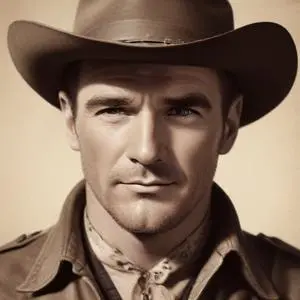
Star of numerous classic Westerns, known for his rugged, stoic persona and iconic roles in films like "Ride the High Country" and "The Searchers".
Known as the "Last of the Great Western Stars," Randolph Scott is an American film actor whose illustrious career spanned over three decades, with a repertoire of over 100 films, more than 60 of which were Westerns. He is celebrated for his rugged, lanky figure, and distinctive Southern drawl, which captivated audiences worldwide.
Born on January 23, 1898, in Orange County, Virginia, Scott was reared in Charlotte, North Carolina, as the second of six children to parents of Scottish descent. His father, George Grant Scott, was the first person licensed as a certified public accountant (CPA) in North Carolina, and his mother, Lucille Crane Scott, came from a wealthy North Carolina family. Scott's family's financial status allowed him to attend private schools, such as Woodberry Forest School, where he developed his athleticism, excelling in football, baseball, horse racing, and swimming.
In April 1917, the United States entered World War I, and Scott joined a unit of the North Carolina National Guard. He was trained as an artillery observer and earned promotions to corporal and sergeant before entering active duty at Fort Monroe, Virginia, as a member of the 2nd Trench Mortar Battalion. After the war, Scott's early career began in the 1920s, with small roles on stage and screen, eventually leading to his film debut in We Americans (1928).
Throughout the 1930s and 1940s, Scott established himself as a leading man in dramas, comedies, and musicals. However, it was his roles in Westerns that truly cemented his status as a Hollywood icon. With films like Bell of San Angelo (1947), Ride the High Country (1962), and The Searchers (1956), Scott's collaboration with director Budd Boetticher produced some of the most memorable Westerns of all time.
Scott's remarkable career was recognized with several accolades, including being a consistent box office draw during the early 1950s. He appeared on the list of the annual Motion Picture Herald Top Ten Polls for four consecutive years, from 1950 to 1953, and in Quigley's Top Ten Money Makers Poll from 1950 to 1953.
Scott's personal life was marked by his marriage to Patricia Stillman in 1936, with whom he had two children. After retiring from acting in 1962, Scott lived a quiet life, enjoying his hobbies, such as horse racing and swimming. He passed away on March 2, 1987, leaving behind a legacy as one of the most beloved Western stars of all time.
Randolph Scott's influence on Western cinema and popular culture is undeniable. He inspired generations of actors, including Clint Eastwood, and filmmakers, such as Quentin Tarantino. Scott's iconic roles and memorable performances continue to captivate audiences today, solidifying his place as a true Hollywood legend.
Randolph Scott's enduring legacy serves as a testament to the power of Western cinema and his own unique contribution to the genre. As the "Last of the Great Western Stars," Scott's impact on Hollywood and popular culture continues to inspire and captivate audiences to this day.
Born in 1904
Debonair leading man of Hollywood's Golden Age, starring in iconic romantic comedies and dramas, known for suave charm and witty banter.
Born in 1901
Iconic star of Hollywood's Golden Age, known for his distinctive drawl and stoic, rugged on-screen presence in classic Westerns and dramas.
Born in 1912
Leading man of 1930s-1950s films, starring in musicals and westerns, including the iconic "Miracle on 34th Street".
Born in 1908
Iconic leading man of Hollywood's Golden Age, starring in classics like "It's a Wonderful Life" and "Rear Window", bringing everyman charm to cinematic legends.
Born in 1905
Iconic actor of Hollywood's Golden Age, starring in classics like "The Grapes of Wrath" and "On Golden Pond", earning him two Oscars and a lifetime of critical acclaim.
Born in 1916
Academy Award-winning actor and humanitarian, renowned for iconic roles in films like "Roman Holiday" and "To Kill a Mockingbird", advocating for social justice and children's rights.
Born in 1923
Iconic actor and director who brought biblical epics and historical dramas to life on the big screen, while also championing Second Amendment rights.
Born in 1913
Academy Award-winning actor and acrobat, known for his charismatic performances in classic films like "From Here to Eternity" and "The Birdman of Alcatraz".
