


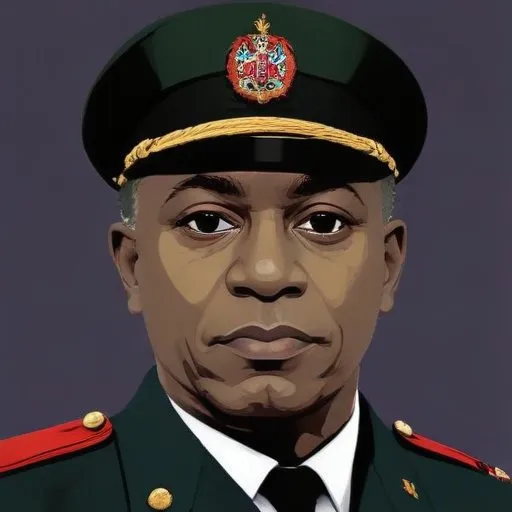
A Haitian military leader who seized power in a 1991 coup, ruling the country with an iron fist until international pressure forced him to step down in 1994. He's infamous for his brutal regime and human rights abuses.
Raoul Cdras, a Haitian former military officer, is notoriously known for being the de facto ruler of Haiti from 1991 to 1994, marking the end of the country's military regime. During his reign, he was responsible for the 1991 Haitian coup d'état that ousted President Jean-Bertrand Aristide, leading to a period of turmoil and human rights abuses.
Born on July 9, 1949, Cdras, a mulatto, was educated in the United States at the School of the Americas and later trained with the Spanish military. This foreign education and training laid the foundation for his future involvement in Haitian politics.
Chosen by the US and France to oversee security for the 1990-1991 Haitian general election, Cdras's influence grew rapidly. He was subsequently named Commander-in-Chief of the Armed Forces by President Aristide in early 1991. However, his allegiance was not solely with Aristide, as he also served as an important source for the CIA, providing reports critical of the president.
As Lieutenant General in the Forces Armées d'Haïti (FAdH), Cdras orchestrated the 1991 Haitian coup d'état, ousting President Aristide on September 29, 1991. During his three-year rule, human rights groups accused the FAdH military and FRAPH paramilitary units of murdering over 3,000 men, women, and children.
Although Cdras was the de facto leader of Haiti, he preferred not to hold the official title of president. Instead, he allowed other politicians to fill the role, including Supreme Court Justice Joseph Nrette and later, Justice émile Jonassaint. This move was seen as undemocratic and sparked international criticism.
In 1994, under pressure from the international community, Cdras relinquished power, and Aristide was reinstated as president. Cdras's rule marked the end of Haiti's military regime, paving the way for democratic reforms. However, his legacy is marred by allegations of human rights abuses and extrajudicial killings.
Little is known about Cdras's personal life, as he has maintained a low profile since leaving power. His current whereabouts and activities remain a mystery, leaving many to wonder about the long-term impact of his rule on Haitian society.
Raoul Cdras's tumultuous reign serves as a reminder of the dangers of unchecked military power and the importance of democratic institutions. As Haiti continues to navigate its complex political landscape, the lessons of Cdras's rule remain a vital part of the country's history.
73 Years Old
A Haitian priest-turned-politician who served as President of Haiti, known for his advocacy for the poor and his tumultuous presidency marked by controversy and exile.
83 Years Old
Agronomist and politician who served as President of Haiti, implementing reforms and rebuilding efforts after natural disasters. Known for his efforts to stabilize and develop the country.
78 Years Old
The first female Prime Minister of Haiti, serving from 2008 to 2009, known for her efforts to rebuild the country after a series of natural disasters and political turmoil. She played a key role in stabilizing the government and promoting economic development.
68 Years Old
The first black person to hold the position, serving as the representative of the Canadian monarch, and a champion for arts and culture. She played a crucial role in promoting diversity and inclusivity in Canada.
