


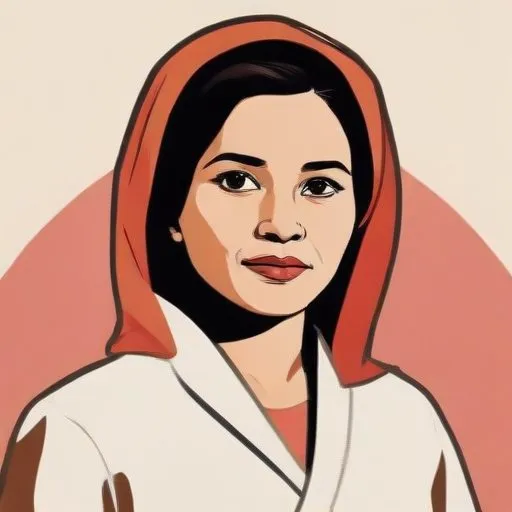
Indonesian women's rights pioneer who fought for independence and gender equality through her writings and activism, inspiring generations of women to demand their rights.
Rasuna Said is revered as a pioneering figure in Indonesia's struggle for independence and a passionate advocate for women's rights, particularly in education and political participation. As a leading figure in various political organizations and a member of the Provisional People's Representative Council and the Supreme Advisory Council, she played a pivotal role in shaping Indonesia's political landscape.
Rasuna Said was born on September 14, 1910, in Maninjau, Indonesia, into a devout Muslim family. She grew up in her uncle's household, as her father's work often took him away from home. Unlike her siblings, she attended a religious school, which later influenced her involvement in religious and political activism.
In 1923, she became an assistant teacher at the Diniyah Putri girls' school, founded by Rahmah el Yunusiyah, where she combined religious and secular subjects. After the school was destroyed by an earthquake, she returned to her hometown and later studied for two years at a school linked to political and religious activism.
In 1926, Rasuna Said joined the communist-affiliated Sarekat Rakyat (People's Union) organization, which was later dissolved following a failed communist uprising in West Sumatra in 1927. She then became a member of the Islamic Union Party, rising to a leadership position in the Maninjau branch.
In 1930, she joined the Union of Indonesian Muslim Students, where she attended speeches on nationalism and Indonesian independence. Her involvement in these organizations laid the groundwork for her future leadership roles in Indonesian politics.
After Indonesia declared independence in 1945, Rasuna Said became a member of the Provisional People's Representative Council and the Supreme Advisory Council under Sukarno's tenure. Her contributions to Indonesia's struggle for independence earned her recognition as an Indonesian national heroine.
Throughout her career, Rasuna Said emphasized the importance of education and political participation for women. Her tireless efforts to promote women's rights and empowerment inspired a generation of Indonesian women to engage in politics and assume leadership roles.
In recognition of her contributions to Indonesia's independence and women's rights, Rasuna Said was posthumously awarded the title of Indonesian National Heroine.
Rasuna Said's indomitable spirit and unwavering commitment to Indonesian independence and women's rights have left an enduring legacy. She paved the way for future generations of women to participate in politics and assumption of leadership roles, inspiring a new era of empowerment and equality in Indonesia.
"Education is the key to unlocking the potential of women and empowering them to participate in the development of our nation."
Rasuna Said's inspiring words continue to resonate with Indonesians, emphasizing the importance of education and empowerment in achieving social and political equality.
Born in 1901
Led Indonesia to independence from the Netherlands, serving as the country's first president and implementing a policy of nationalization and industrialization. He's known for his charismatic leadership and vision for a unified Indonesia.
